

Board Performance · 2025
In this section15 topics
- Compliance Monitoring — Overview1 item
- Prevention of Conflicts of Interest3 items
- Prevention of the Use of Inside Information3 items
- Anti-Corruption4 items
- Whistleblowing3 items
- Selection of Directors & Chief Executives6 items
- Selection of Independent Directors2 items
- Director Development1 item
- Evaluation of Board & Subcommittee Performance2 items
- Subcommittees1 item
- Meeting Attendance & Remuneration6 items
- Supervision of Subsidiaries & Associated Companies5 items
- Board Duty Performance — Overview1 item
- Audit Committee Duty Performance1 item
- Executive Committee Duty Performance1 item
Compliance Monitoring — Overview
Compliance Monitoring — Introduction
The Company places importance on good corporate governance. It has established goals, visions, objectives, policies, and relevant practices in its Corporate Governance Policy, Code of Business Conduct, and Work Ethics, including promoting actual implementation to build confidence among all stakeholders. To support future business growth, the Company has formulated appropriate policies to ensure operational efficiency, including emphasizing employees' understanding of good corporate governance, anti-corruption, conflicts of interest, and the use of inside information for personal gain. It has established measures for reporting clues or complaints, illegal acts, unethical conduct, or behavior that may indicate corruption or misconduct.
In the past year, the Company has monitored the implementation of good corporate governance covering 1) Employee care and non-discrimination, 2) Antitrust and fair competition, 3) Environmental care, occupational health and safety, and 4) Information security. The monitoring results indicate that the Company has fully implemented the guidelines for each issue.
Prevention of Conflicts of Interest
Has the Company Acted to Prevent Conflicts of Interest?
Yes
Operations in the Past Year
The company has established a policy that directors, executives, and employees must perform their duties for the best interests of the company. They must avoid any actions that may conflict with the company's interests, which may arise from 1) Contacting the company's business associates, such as customers, partners, etc. 2) Using the company's opportunities or inside information for personal gain. 3) Entering into transactions with the company. 4) Doing business that competes with the company, etc. In the event that any person has an interest or involvement in the considered transaction, such person must notify the secretary of the meeting of each board of directors who oversees such matters and refrain from considering such transactions.
In 2025, the Company reviewed cases that may have caused conflicts of interest. No issues were found as mentioned. In the past year, the Board of Directors approved the review of the conflict of interest prevention policy at its meeting 3/2025 on August 14, 2025.
Number of Conflict-of-Interest Cases
| Metric | Current Year | Previous Year | Two Years Ago |
|---|---|---|---|
| Total number of cases or issues related to conflicts of interest (cases) | 0 | 0 | 0 |
Prevention of the Use of Inside Information
Has the Company Acted to Prevent the Use of Inside Information?
Yes
Operations in the Past Year
The company oversees the use of inside information in accordance with the law and good corporate governance principles. It has established a written policy on the prevention and control of the use of inside information for personal gain, which has been approved by the Board of Directors and is reviewed annually by the Board of Directors. In summary, the key policies are as follows:
1) Prohibit directors, executives, employees, and employees of the company who are aware of material inside information that could affect the price of securities from using inside information to buy, sell, transfer, or accept the transfer of securities or futures contracts issued by the company before such information is made public. Especially during the 30 days prior to the company's financial statements or information that could affect the price of securities being released to the public. In addition, after the information has been disclosed, such persons are prohibited from buying, selling, transferring, or accepting the transfer of securities or futures contracts issued by the company until the public has had sufficient time to evaluate the information received (at least 24 hours from the date and time of disclosure). Those involved with inside information must not disclose such information to others until it has been reported to the Stock Exchange of Thailand.
2) Prohibit directors, executives, employees, and persons related to inside information from disclosing or transmitting inside information or company secrets to unrelated persons, including family members, relatives, friends, etc.
3) The company places importance on preventing the use of inside information for improper benefit or to diminish the company's interests or create conflicts of interest. This is stipulated in the corporate governance policy, code of conduct and work practices, employment contracts, and work regulations.
For the blackout period, the Board of Directors assigns the company secretary to inform the directors, executives, and employees who are aware of material inside information before the information is disclosed to the public.
During the past year, no directors, executives, or employees with inside information were found to have traded in securities during the company's blackout period.
Number of Inside-Information Cases
| Metric | Current Year | Previous Year | Two Years Ago |
|---|---|---|---|
| Total number of cases or issues related to the use of inside information to seek benefits (cases) | 0 | 0 | 0 |
Anti-Corruption
Has the Company Acted on Anti-Corruption?
Yes
Operations in the Past Year
The company has established an anti-corruption policy and procedures. The Board of Directors has assigned the Audit Committee to oversee the internal control system, and the management is responsible for raising awareness and communicating the honest performance of duties to all employees.
In the past year, the company has taken actions to combat corruption as follows:
1) All new employees must receive orientation training to raise awareness and understanding of anti-corruption, which is the company's policy and one of the ethics and codes of conduct. All employees of the company will have an annual ethics and code of conduct assessment, conducted by the Internal Audit Department, and the assessment results will be reported to the Audit Committee.
2) Send e-mails to communicate to employees about the anti-corruption policy, business ethics, and code of conduct.
In addition, the company has also reviewed the adequacy of the anti-corruption process, which the Audit Committee has assigned the Internal Audit Department to conduct annually.
Form of Anti-Corruption Operations
| Operation |
|---|
| Assessment and identification of corruption risk |
| Communication and training for employees on anti-corruption policy and guidelines |
| The monitoring of the evaluation of compliance with the anti- corruption policy |
| Review of the completeness and adequacy of the process by the Audit Committee or auditor |
| The participation in anti-corruption projects |
| Review of appropriateness in anti-corruption |
Number of Corruption Cases
| Metric | Current Year | Previous Year | Two Years Ago |
|---|---|---|---|
| Total number of cases or issues related to corruption (cases) | 0 | 0 | 0 |
Whistleblowing
Has the Company Implemented Whistleblowing Procedures?
Yes
Operations in the Past Year
The Company has provided channels for stakeholders to report whistleblowing and complaints through the following channels: 1) Suggestion and complaint boxes within the Company; 2) Direct reporting of whistleblowing and complaints to trusted supervisors at all levels, Human Resources Planning, Company Secretary, Audit Committee, and the Board of Directors; 3) Email; 4) Company website; and 5) Postal mail. The Company Secretary will act as a coordinator for receiving, delivering, following up on the investigation results, and compiling the cases for all whistleblowing and complaint channels. In the event that the Head of Internal Audit is the subject of a complaint, the Audit Committee will appoint an Investigation Committee to act accordingly.
In the past year, there have been no reports of whistleblowing or complaints related to illegal activities or breaches of business ethics and codes of conduct, violations, financial misstatements, fraud and corruption, or deficiencies in internal control through these channels.
Number of Whistleblowing Cases
| Metric | Current Year | Previous Year | Two Years Ago |
|---|---|---|---|
| Total number of cases or issues received through whistleblowing channels (cases) | 0 | 0 | 0 |
Selection of Directors & Chief Executives
Selection, Development & Evaluation — Introduction
In considering the selection of directors and senior executives, the Board of Directors has assigned the Nomination and Remuneration Committee, which consists of two independent directors out of three, to be responsible for the recruitment, selection, and screening of qualified individuals to serve as directors. This ensures that the directors possess the knowledge, abilities, professionalism, and diversity appropriate for the structure, size, and composition of the Board. The Committee then submits its recommendations to the Board of Directors for approval before presenting the list of candidates to the shareholders' meeting for election according to the following criteria:
Director Recruitment
The selection criteria are based on the qualifications stipulated in Section 68 of the Public Limited Companies Act B.E. 2535 and the Notification of the Board of the Securities and Exchange Commission (Notification of the Capital Market Supervisory Board No. TorJor. 39/2559 Re: Application for Permission and Permission to Offer Newly Issued Shares) and/or relevant laws. In addition, the Company's directors must not possess any prohibited characteristics according to the Securities and Exchange Act or the criteria set by the SEC Office. They must also not exhibit any characteristics that indicate a lack of suitability to be entrusted with the management of a company with public shareholders as determined by the SEC Office (according to the Notification of the SEC Board No. KorJor. 3/2560 Re: Determination of Lack of Reliability of Directors and Executives of Companies).
In voting for the election of directors, the Company allows shareholders to vote for the appointment of directors to replace retiring directors by voting for each director individually. Shareholders may cast all of their votes for each nominated director. The outcome of the vote must receive a majority of the total votes of the shareholders present at the meeting and entitled to vote.
In 2025, no shareholder-nominated candidates were submitted to the Nomination and Remuneration Committee. Therefore, the Nomination and Remuneration Committee considered the retiring directors proposed at the 2025 Annual General Meeting of Shareholders. The Committee considered the elements of the Nomination and Remuneration Policy and screened the qualifications of each director in various aspects, including knowledge, ability, and experience that would be beneficial to the Company's business operations. The Committee also ensured that the candidates have no legal disputes, have never been dismissed or removed from office for fraud, and have never been imprisoned for offenses related to fraud. The Committee also considered the remuneration of the Board of Directors at the 2025 Annual General Meeting of Shareholders on April 25, 2025, which was approved by the meeting's resolution.
Directors & Chief Executives — Introduction
Director Selection Criteria
Nomination of New Directors Considered from the following elements:
1) Possessing qualifications in accordance with relevant laws and regulations, and the Company's Articles of Association.
2) Being a qualified individual with diverse knowledge, abilities, and experience in various professions that are beneficial to the performance of duties as a director.
3) Necessity for the missing element in the Board's structure, considering the Skill Matrix, such as engineering, law, finance, accounting, economics, security, and management, to integrate knowledge and abilities that are beneficial to the Company's operations.
4) Having any conflict of interest that may arise with the Company.
5) Consent from the nominees for consideration.
Nomination of Existing Directors Considered from the following elements:
1) Performance in the past year.
2) Providing useful suggestions and feedback to the organization.
3) Dedication of time to the organization.
4) Participation in various activities by each director.
Chief Executive Officer Recruitment
The Nomination and Remuneration Committee is responsible for selecting individuals for the position of Chief Executive Officer. The selection process for vacant positions is based on the following criteria:
1) Being a director of the Company in accordance with the Company's Articles of Association.
2) Characteristics
(a) Having integrity and accountability.
(b) Making decisions based on information and reason (Informed judgment).
(c) Mature and stable, a good listener, and able to express different opinions independently.
(d) Adhering to working with principles.
3) Having knowledge and ability in business operations, possessing skills, experience, professionalism, and specific qualifications in various fields that are essential and highly beneficial to the Company's business.
4) Meet the qualifications criteria set by the Securities and Exchange Commission and the Stock Exchange of Thailand.
5) Experience in energy, petroleum, petrochemical businesses, and corporate management that will enhance the Company's operational efficiency and competitiveness.
6) Experience in being an organizational leader with high leadership qualities.
7) Recognition from relevant business organizations.
8) Approval from the Board of Directors.
Executive Recruitment
The Board of Directors has established a succession planning policy for senior executives, including the positions of Chief Executive Officer, Chief Operating Officer, Chief Strategy Officer, and Chief Financial Officer. The policy outlines clear procedures, with the Nomination and Remuneration Committee responsible for considering and proposing candidates to the Board of Directors for their consideration. The Board of Directors monitors the succession plan annually.
Are Directors Selected Through the Nomination Committee?
Yes
Are Chief Executives Selected Through the Nomination Committee?
Yes
Rights of Minority Shareholders on Director Appointment
Recognizing the importance of shareholder rights and equality in accordance with good corporate governance principles, the Board of Directors of Premier Tank Corporation Public Company Limited (the "Company") has provided an opportunity for the Company's shareholders to propose matters that they deem beneficial to the Company for consideration to be included in the agenda of the shareholders' meeting. This includes providing an opportunity for shareholders to nominate qualified individuals for consideration for election as directors of the Company in advance.
Shareholder Qualifications
A single shareholder or a group of shareholders holding shares and having the right to vote representing not less than 5 percent of the total voting rights of the Company and must have held shares of the Company in the specified proportion continuously until the date of proposing the agenda of the meeting and/or nominating the person, including being able to show supporting documents certifying shareholding.
The Company provided an opportunity for minority shareholders to nominate individuals for consideration for election as directors of the Company during the period from November 15, 2025, to January 15, 2026, through the Stock Exchange of Thailand's news system. The Company also disclosed the guidelines for such process, including the nomination form, on the Company's website for the shareholders' information in advance. As a result, there were no shareholders who nominated individuals for consideration for election as directors of the Company.
Method of Director Appointment
| Method |
|---|
| Method whereby each director requires approval votes more than half of the votes of attending shareholders with voting rights |
Selection of Independent Directors
Criteria for Selecting Independent Directors
Composition and Appointment of Independent Directors
In selecting and proposing the appointment of independent directors, the number of independent directors on the Board of Directors shall be considered. The independent directors must constitute at least one-third of the total number of directors of the company and shall be in accordance with the qualifications of independent directors.
Qualifications of Independent Directors
Qualifications of persons to serve as independent directors are considered based on the qualifications and prohibited characteristics of directors under the Public Limited Company Act, the Securities and Exchange Act, the notifications of the Securities and Exchange Commission, the notifications of the Capital Market Supervisory Board, the notifications of the Stock Exchange of Thailand, as well as relevant announcements, regulations, and/or rules. In addition, the Board of Directors will consider selecting independent directors from qualified individuals with work experience and other appropriate qualifications. The company aims to appoint at least one-third of the total number of directors of the company as independent directors, but not less than three, with the following qualifications:
1. Hold not more than one percent of the total voting shares of the company, its parent company, subsidiary, affiliated company, or any juristic person that may have a conflict of interest. This includes the shareholding of the related persons of such independent director.
2. Not be or have been a director, executive, employee, salaried consultant, or controlling person of the company, its parent company, subsidiary, affiliated company, or any juristic person that may have a conflict of interest, unless such person has ceased to hold such position for at least two years prior to assuming the position.
3. Not be a person who has a blood relationship or a relationship by registration under the law as a father, mother, spouse, sibling, child, including the spouse of a child, of an executive, a major shareholder, a controlling person, or a person who will be proposed to be an executive or a controlling person of the company, its subsidiary, or affiliated company.
4. Have no or have had no business relationship with the company, its parent company, subsidiary, affiliated company, or any juristic person that may have a conflict of interest in a manner that may hinder the independent director's independent judgment, including not being or having been a major shareholder, a non-independent director, or an executive of a person who has a business relationship with the company, its parent company, subsidiary, affiliated company, or any juristic person that may have a conflict of interest, unless such person has ceased to hold such position for at least two years prior to assuming the position. The business relationship under clause (4), paragraph 1, includes conducting ordinary trade or business, leasing or subleasing of immovable property, transactions relating to assets or services, or the provision or receipt of financial assistance by way of borrowing or lending, guaranteeing, providing assets as security for debts, including other similar acts, which result in the applicant or the counterparty having a liability to pay to the other party of at least three percent of the net tangible assets of the applicant or twenty million baht or more, whichever is lower. The calculation of such liabilities shall be in accordance with the method of calculating the value of connected transactions under the Notification of the Capital Market Supervisory Board Re: Rules on Connected Transactions, mutatis mutandis. However, in considering such liabilities, the liabilities incurred during the one-year period prior to the date of having a business relationship with the same person shall be included.
5. Not be or have been an auditor of the company, its parent company, subsidiary, affiliated company, or any juristic person that may have a conflict of interest, and not be a major shareholder, a non-independent director, an executive, or a managing partner of an audit firm to which the auditor of the company, its parent company, subsidiary, affiliated company, or any juristic person that may have a conflict of interest belongs, unless such person has ceased to hold such position for at least two years prior to assuming the position.
6. Not be or have been a provider of any professional services, including legal or financial advisory services, that receives fees exceeding two million baht per year from the company, its parent company, subsidiary, affiliated company, or any juristic person that may have a conflict of interest. In the case where the professional service provider is a juristic person, this includes being a major shareholder, a non-independent director, an executive, or a managing partner of such professional service provider, unless such person has ceased to hold such position for at least two years prior to assuming the position.
7. Not be a director appointed to represent a director of the company, a major shareholder, or a shareholder who is related to a major shareholder of the company.
8. Have no other characteristics that would prevent them from providing independent opinions on the operations of the company.
After being appointed as an independent director who meets the criteria set forth in (1) to (8), the independent director may be authorized by the Board of Directors to make decisions in the business operations of the company, its parent company, subsidiary, affiliated company, or any juristic person that may have a conflict of interest, by way of a collective decision.
Did Any Independent Director Have a Business or Professional Relationship?
No
Director Development
Director Development — Introduction
The Board of Directors has a policy to promote and facilitate training and knowledge provision to the Board of Directors and sub-committees. The Company Secretary is assigned to propose a training budget to the Board of Directors. When there are courses deemed important and beneficial to the Directors, such as the Director Accreditation Program organized by the Thai Institute of Directors Association, the Company Secretary will inform the Directors to inquire about their willingness to participate and arrange for training as necessary and appropriate. In addition, when a new Director joins the Board, the Company Secretary will coordinate a meeting between the new Director and the management team to provide information related to the company, including its history, nature of business, shareholding structure and organization, and other necessary matters, as well as conduct a site visit.
For employees, the Chief Executive Officer has assigned the Human Resources Department to survey training needs and allocate an annual budget for training interested employees.
Evaluation of Board & Subcommittee Performance
Criteria for Evaluating Board Performance
Board Performance Evaluation
The Board of Directors has arranged for an annual individual performance evaluation of each director (Director self-Assessment) to allow each director to express their opinions on their performance. This is to help consider the performance, problems, and obstacles encountered during the past year.
Chief Executive Officer (CEO) Performance Evaluation
Evaluation Criteria and Procedures
The Board of Directors has assigned the Nomination and Remuneration Committee to evaluate the performance of the Chief Executive Officer (CEO) annually, at least once a year, on topics such as leadership, strategy setting, strategy implementation, financial planning and performance, board relations, external relations, work management and employee relations, succession planning, product and service knowledge, and personal attributes. The secretary of the Nomination and Remuneration Committee will send the evaluation form to the Nomination and Remuneration Committee to assess the performance. The evaluation results will be discussed at the Nomination and Remuneration Committee meeting without the presence of interested parties and then submitted to the Board of Directors for further consideration.
Evaluation of Board Performance in the Past Year
Board of Directors' Evaluation Results
For the year 2025, the Board of Directors' (BOD) self-assessment consists of 6 sections: Section 1: Board Structure and Attributes, Section 2: Roles, Duties, and Responsibilities of the Board, Section 3: Board Meetings, Section 4: Board Performance History, Section 5: Relationship with Management, and Section 6: Director Development. The evaluation results show an average score of 99.48%, which is considered "Excellent". The individual Board member performance evaluation (self-assessment) consists of 5 criteria: Personal Attributes, Readiness to Perform Duties, Meeting Participation, Roles, Duties, and Responsibilities, and Relationships with the Board and Management. The evaluation results show an average score of 99.70%, which is considered "Excellent".
Chief Executive Officer (CEO) Evaluation Results
In 2025, the Nomination and Remuneration Committee reviewed the Chief Executive Officer's performance evaluation based on the aforementioned format and expressed satisfaction with the overall performance. The Committee reported to the Board of Directors at the 4/2025 Board Meeting on November 13, 2025, for consideration of the Chief Executive Officer's performance. The overall performance evaluation score for the Chief Executive Officer in 2025 was 99.38%.
Subcommittees
Subcommittees
| Results of the Subcommittee's Duty Performance |
|---|
The Risk, Governance, and Sustainability Committee considered various matters and reported the meeting results along with its opinions to the Board of Directors for consideration, summarizing the key aspects of the committee's performance as follows: 1. Consider and review the charter of the Risk, Governance, and Sustainability Committee. Considered and reviewed the charter for suitability, which specifies the scope of duties and responsibilities and best practices, to serve as an operational standard for the Risk, Governance, and Sustainability Committee and to enable the committee to perform its duties to achieve the company's objectives. 2. Consider and review the risk management policy and risk management operating procedures. Considered and reviewed the risk management policy for suitability to establish a framework for the company's risk management processes and to implement it throughout the organization, and to ensure that responsibilities for controlling identified risks are appropriately assigned. 3. Review business risk factors, risk classification, and risk control activities for 2025. Reviewed various business risk factors for 2025 comprehensively and thoroughly in line with current situations, and provided opinions on whether risk control activities are complete and sufficient to mitigate potential impacts on the organization in both the short and long term, and presented them to the Board of Directors for consideration quarterly. 4. Consider the risk management plan and annual follow-up for 2025. Considered the risk management plan and annual follow-up for 2025 to ensure maximum efficiency in risk management. 5. Consider the review of the corporate governance policy, business ethics, and anti-corruption policy and guidelines, and present them to the Board of Directors for approval. 6. Monitor the implementation of Governance, Risk, and Compliance (GRC) integration and report to the Board of Directors. Based on the aforementioned performance, the Risk, Governance, and Sustainability Committee has performed its duties and responsibilities as stipulated in its charter, and has continuously reported meeting results to the Board of Directors quarterly. Therefore, in 2025, the Risk, Governance, and Sustainability Committee can operate comprehensively, with due diligence and independence, and has provided candid opinions for the utmost benefit of shareholders and all stakeholders. Furthermore, it is committed to operating using enterprise risk management principles and further developing internal risk management systems in accordance with international guidelines. Joint meeting between the Audit Committee and the Risk, Governance, and Sustainability Committee. The Risk, Governance, and Sustainability Committee held a joint meeting with the Audit Committee, with the company's risk management working group responsible for considering the structure, policies, risk management framework, risk management plan, risk review, and monitoring of the company's risk management. The committee considered all 8 types of risks as follows: (1) Strategic Risk, (2) Operation Risk, (3) Financial Risk, (4) People Risk, (5) Technological Risk, (6) Compliance Risk, (7) Fraud Risk, and (8) Incident Risk. Regular quarterly reports are provided, ensuring that the company's risk management is efficient and effective, and yields maximum benefits. GRC IntegrationPremier Tank Corporation Public Company Limited ("the Company") considers operating for sustainability as a company with a strong foundation and flexibility in adapting strategies and management. It manages to achieve operational goals and strategies, viewing corporate governance, risk management, and compliance (GRC) as an integrated matter, under the GRC framework by the Thai Institute of Directors (Thai IOD) to serve as a good practice guideline for the Board of Directors. This GRC-based operation supports the Company's mission: "To be a stable and strong value chain in the country's infrastructure system, based on sustainable and caring management principles, to be a business partner of choice for customers."
The Company conducts business by assessing changes in the context and environment (Landscape and environment) and their impact on the Company's operational plans. The Board of Directors monitors management to consider and present this information when strategic and business plans are proposed, covering both normal business operations and the creation of new businesses, to enhance competitiveness and sustainable growth in the future. This consistent assessment of changes in context and environment aligns with the Company's three operational goals: (1) "Increase efficiency in oil receipt and delivery by supporting various transfer methods and increasing the number of service stations receiving oil from the Company's depots," (2) "Develop infrastructure to enhance energy delivery efficiency, ensuring equitable access to energy for all areas," and (3) "Create new businesses related to the vision and mission to diversify revenue streams and reduce reliance on any single business." The Board of Directors oversees management, considering elements such as (1) Organizational structure and governance (Governance), potential risk management and control (Risk and Control Continuum), by identifying and analyzing risks, as well as monitoring and supervising risk management policies to align with the Company's vision, mission, goals, and operational strategies. (2) Operations in compliance with internal and external laws, rules, and regulations (Compliance), including related legal aspects, accounting standards, compliance with industry standards, information disclosure, and other operational aspects. And (3) The structure or approach to building assurance (Assurance) that operational plans align with the mission and the three aforementioned operational goals, and are correctly implemented and executed through the Executive Committee and the Board of Directors under a desirable organizational culture and behavior (Culture, behavior, and change). The Company aims to promote and develop personnel with appropriate numbers, knowledge, skills, experience, and motivation, as well as having sources of information and knowledge (Knowledge and data) that can be used to analyze and assess the environment and business. This operation leads to the protection and creation of value for the Company (Value protection and creation). The Board of Directors oversees the management to present the above information, adapting it to the business growth level, aligning with operational guidelines and the environment, and ensuring it is integrated (Business, maturity, relevance, integration, and convergence). The Board of Directors, together with management, leads the implementation of these matters, takes responsibility for various outcomes, and monitors to ensure confidence in operational efficiency (Leadership, accountability, and assurance) by performing duties with responsibility, diligence, integrity towards the organization, and ensuring operations comply with laws, regulations, and resolutions of shareholder meetings. Corporate Governance ( Governance ) The Board of Directors has continuously updated policies, practices, and good corporate governance systems to enhance the Company's governance efficiency and elevate its corporate governance standards to align with the Principles of Good Corporate Governance for Listed Companies 2017 (Corporate Governance Code or CG Code) of the Securities and Exchange Commission, as follows: In 2025, the Board of Directors approved the review/revision of policies, practices, and good corporate governance systems, as follows: 1. Approved the review of 23 Company policies for 2025 to ensure their suitability with current situations and changes. 2. Approved the policy for supervising subsidiaries and associated companies to safeguard the Company's interests. Risk ( Risk)The Company recognizes the importance of risk management, compliance with laws and regulations, and the preparation of reliable reports. Risk identification and analysis consider both internal and external factors that may affect business operations, to achieve objectives comprehensively across the entire organization. This includes consideration at the organizational, departmental, and divisional levels, as risk management is considered a crucial component of all business processes and must be interconnected at all levels. Therefore, a risk management policy and a risk management manual have been established and communicated to all executives and employees for their awareness and compliance. Risk is assessed at all levels, and high risks are used to develop an enterprise risk management plan, which identifies risk factors or causes, impacts, existing control measures, and additional measures to mitigate risks, with quarterly monitoring. The Company has a Risk Management Committee, which is a sub-committee responsible for overseeing and supporting enterprise risk management operations to align with business strategies and goals, as well as changing circumstances. It also provides recommendations, monitors, and evaluates to ensure maximum overall risk management effectiveness. For the year 2025, the Risk Management, Corporate Governance, and Sustainability Committee has fully performed its duties in accordance with its Charter, as assigned by the Board of Directors. The key aspects of its performance can be summarized as follows: 1. Consider reviewing the Charter of the Risk Management, Corporate Governance, and Sustainability Committee. Consider reviewing the Charter for suitability, which specifies the scope of duties and responsibilities and good practices to serve as an operational standard for the Risk Management, Corporate Governance, and Sustainability Committee, and to enable it to perform its duties to achieve the Company's objectives. 2. Consider reviewing the Risk Management Policy and Risk Management Operating Procedures. Consider reviewing the risk management policy for suitability, to establish a framework for the Company's risk management processes and implement it throughout the organization, and to ensure that responsibilities for controlling identified risks are appropriately defined. 3. Review business risk factors, risk classification, and risk control activities for 2025. Thoroughly review various business risk factors for 2025 to ensure comprehensive coverage and alignment with current situations. Also, provide opinions on whether risk control activities are complete and sufficient to mitigate potential short-term and long-term impacts on the organization, and present them to the Board of Directors' meeting for consideration every quarter. 4. Consider the risk management plan and its annual follow-up for 2025. Consider the risk management plan and its annual follow-up for 2025 to ensure maximum risk management efficiency. 5. Consider reviewing the Corporate Governance Policy, Business Ethics, and Anti-Corruption Policy and guidelines, and present them to the Board of Directors for approval. 6. Monitor the integration of Governance, Risk, and Compliance (GRC) operations and report to the Board of Directors. Based on the aforementioned performance, the Risk Management, Corporate Governance, and Sustainability Committee has fulfilled its duties and responsibilities as stipulated in the Charter of the Risk Management, Corporate Governance, and Sustainability Committee, and continuously reported meeting outcomes to the Board of Directors every quarter. Therefore, in 2025, the Risk Management, Corporate Governance, and Sustainability Committee can operate fully, with due diligence and independence, and has provided candid opinions for the utmost benefit of all shareholders and stakeholders, while also being committed to performing its duties using enterprise risk management principles and developing internal risk management systems in accordance with international guidelines. Compliance Operations ( Compliance ) The Board of Directors is committed to conducting business in compliance with the law. Company personnel are aware of their respective roles and responsibilities to comply with various internal and external laws, rules, and regulations. The Company has established various policies approved by the Board of Directors, and new regulations are reviewed and monitored annually. Additionally, there are operating procedures and manuals, aiming to ensure employees are aware of compliance with various internal and external regulations. For compliance operations, the Company engaged Audit House Co., Ltd. ("AUDIT"), which was assigned by Premier Tank Corporation Public Company Limited to act as its internal auditor. AUDIT therefore reviewed the Company's internal control system according to the internal audit project to evaluate the Company's internal control system. It was concluded that the Company has established an internal control system that is sufficient and appropriate for the nature and size of its business. Policies, operating procedures, scopes of responsibility, approval hierarchies for each management level, and operational process control measures are clearly and strictly documented to prevent fraud. Additionally, the Company has an internal audit department that periodically reviews the performance of employees. Regarding compliance operations, they can be divided into 4 types of practices, as follows: Related legal aspects The Company also recognizes the importance of complying with relevant laws and those affecting stakeholders. In accordance with the Personal Data Protection Act B.E. 2562 (2019), the Company has developed separate personal data protection policies for external parties and business partners, and for employees, and published them on the Company's website. This is to ensure that employees and external parties are aware of the organization's intent regarding the handling of personal data, and to inform data subjects of their various rights and to help them understand the purposes and methods of collecting, using, and disclosing personal data, among others. The Company also emphasizes respecting and complying with relevant laws in all areas where it operates. The Board of Directors has stipulated compliance with relevant laws, regulations, rules, and criteria in the Company's ethics and code of conduct. This covers all levels, from the Board of Directors and management to all employees, who must understand and strictly adhere to laws related to the Company's business operations to ensure that the Company's operations are correct and efficient. Compliance with industry standards The Company has certified the following management system standards: 1. The Quality Management System ISO 9001:2015 is an international standard that businesses worldwide prioritize for quality excellence and operational efficiency within the organization. It involves establishing a quality assurance management system, which is a system that ensures various processes are controlled and auditable. This is achieved through a system that specifies work steps and methods, to ensure that personnel within the organization understand their responsibilities and operational procedures. It requires providing training for knowledge and operational skills, recording data, as well as verifying whether operations comply with the system, correcting errors, and implementing measures to prevent recurrence of previous errors. 2. The Occupational Health and Safety Management System ISO 45001:2018 is a standard that helps implement occupational health and safety management systems by establishing a health and safety management system based on minimizing workplace risks and improving overall safety and working conditions. It can identify, analyze, and assess various risks that may affect employees, enabling the Company to find ways or implement preventive measures to improve the working environment. 3. The Environmental Management System ISO 14001:2015 is an international standard for an organization's environmental management system, aimed at enhancing internal environmental performance and environmental sustainability. It systematically manages its environmental responsibilities by using the requirements specified in the environmental management system standard as a guideline for practice, to meet the expectations of the environmental management system. This includes improving environmental performance, ensuring compliance with relevant laws and obligations, and the ability to achieve the organization's own environmental management objectives. This creates value for the organization, stakeholders, the environment, and aligns with the organization's environmental policy, as well as contributing to environmental sustainability. In 2025, the Company engaged a licensed company to inspect the working environment, measuring chemical concentrations, 8-hour average noise levels, heat values in the premises, light intensity in the premises, drinking water quality, and wastewater quality. All items were found to be within standard criteria. The measured wastewater quality was within standard for all parameters, reflecting the Company's commitment to the environment and indicating adherence to its vision of "sustainable and caring management principles." It also aligns with the sustainable development goals as per The 17 Sustainable Development Goals (SDGs) to transform our world, specifically Goal 6 on water management and sanitation: Clean Water and Clean Energy. Accounting standards The Company has prepared financial reports in accordance with accounting standards prescribed by the Federation of Accounting Professions. Furthermore, the Company's auditor, DIA International Audit Co., Ltd., which audited the 2025 financial statements, stated in its audit report that the Company had no material deficiencies in its accounting system. The audit of the 2025 financial statements by the auditor found no risks or deficiencies in the internal control system, thus no Management Letter was prepared for 2025. Furthermore, the auditor additionally reported the results of the 2024 financial statement audit to the Audit Committee, stating that no irregularities related to fraud were found that would materially affect the Company's financial statements. Information disclosure As a company listed on the Stock Exchange of Thailand since February 15, 2022, the Company has prioritized full compliance with the Public Company Limited Act and the Securities and Exchange Act as required by law. Furthermore, the Company regularly sends relevant personnel to attend training on laws pertinent and essential to operations, to ensure employees gain knowledge, understanding, and can apply it in their work. Information disclosure is one of the important principles of good corporate governance. Therefore, the Company places importance on information that must be reported to the Stock Exchange of Thailand and shareholders, in terms of accuracy, sufficiency, timeliness, and equal access to information for all groups. The preparation of such information is in accordance with regulations, with Investor Relations and the Company Secretary performing these duties. Company information comprises financial and non-financial data. In 2025, the disclosure of financial statement information was reviewed/audited by auditors, confirming its material accuracy in accordance with generally accepted accounting principles, and approved by the Audit Committee/Board of Directors before public disclosure. Regarding non-financial information disclosure, the Company disclosed information according to criteria set by the Stock Exchange and the SEC Office, which include related party transactions, dividend payments, management discussion and analysis, notices of meetings, and shareholder meeting minutes. Additionally, good corporate governance reports are included in the annual information statement, Form 56-1 One Report. |
The Board of Directors of Premier Tank Corporation Public Company Limited has established the Nomination and Remuneration Committee, comprised of 3 directors of the company. The committee members are as follows: 1. Dr. Chitrapongse Kwangsukstith 2. Mr. Tassanu Chutikanon 3. Mr. Weerawat Burapapattanapong The Nomination and Remuneration Committee has completely and carefully fulfilled its duties as outlined in the policy and charter reviewed and approved by the Board of Directors. In 2025, the Nomination and Remuneration Committee held a total of 2 meetings, was held in Hybrid Meeting (Physical and Electronic) in Company regulations and Recording pursuant to the Royal Decree on Teleconferences through Electronic Means B.E. 2563.
1. Reviewed the framework for annual executive and employee remuneration to ensure appropriate alignment with the company's economic situation and overall performance. 2. Reviewed the annual succession plan for the CEO and top executives. 3. Considered and nominate qualified persons to be the Company's directors to be the Company’s Director according to the nomination criteria and process of the Company by: 3.1 Nominating an individual to replace the retiring director at the Annual General Meeting of Shareholders. 3.2 Proposing the appointment of an individual to fill the vacant Director position. The Board of Directors has evaluated the qualifications of 3 individuals for appointment as directors to fill the vacant positions. The proposed candidates possess the knowledge, abilities, and experience necessary to benefit the company and meet all qualifications under the Public Limited Companies Act B.E. 2535. 4. Ensured that the company's directors, members of sub-committees, and CEO receive appropriate compensation for their duties and responsibilities, in accordance with their performance. 5. Established a guideline for evaluating performance, in order to assess annual remuneration. 6. Reviewed remuneration and other benefits for the company's directors, members of sub-committees, and CEO, to ensure appropriateness based on their duties and responsibilities, as well as market conditions. 7. Reviewed the policy and charter of the Nomination and Remuneration Committee's Board Skill Matrix and responsibilities, to ensure alignment with the current situation and compliance with the principles of good corporate governance. In conclusion, the Nomination and Remuneration Committee has fulfilled the aforementioned duties, in accordance with the roles and responsibilities assigned by the Board of Directors. It is agreed that, in 2025, the board directors, directors of sub-committees, and Chief Executive Officers possess the necessary knowledge and abilities, and the remuneration and other benefits expressed in the annual report are appropriate to their obligations and responsibilities, in line with the company's economic conditions and overall performance. |
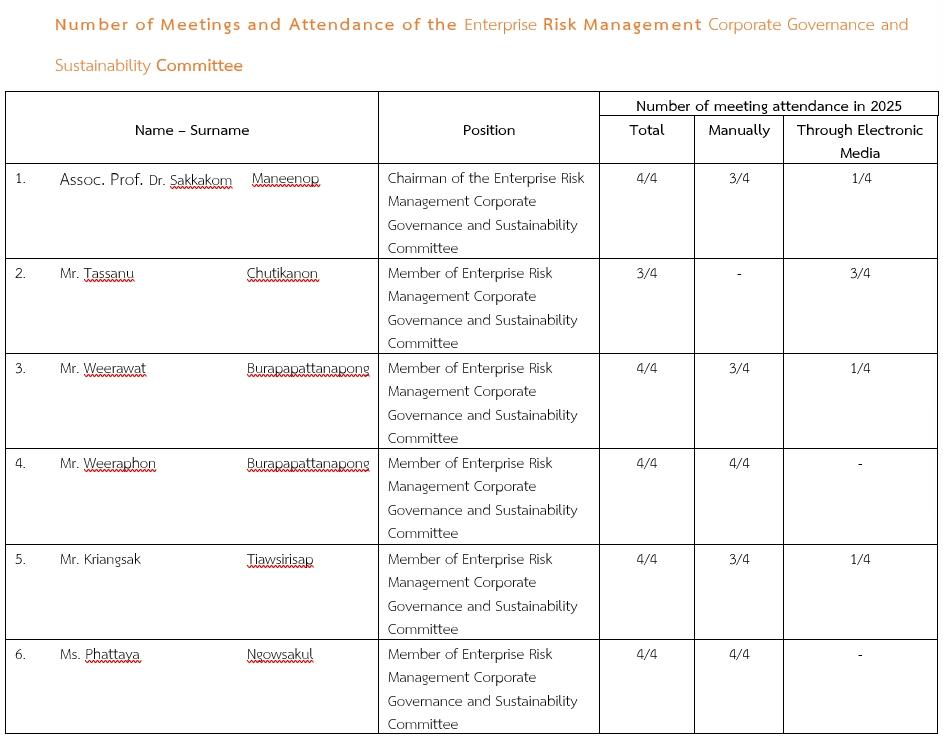

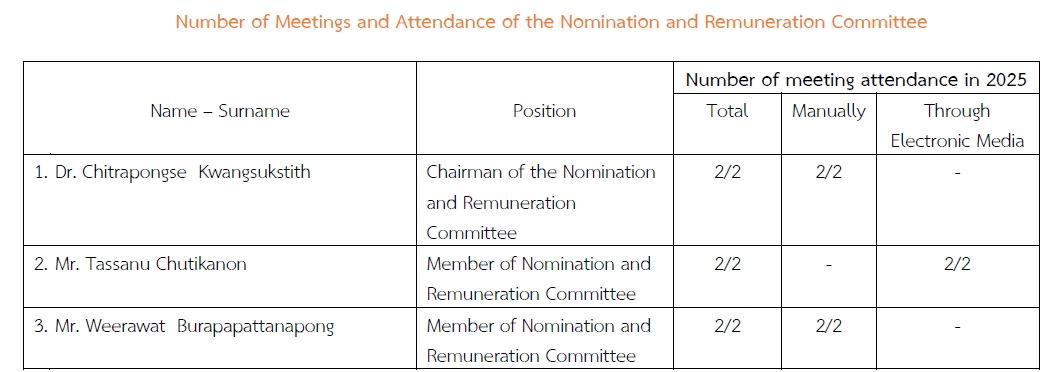
Meeting Attendance & Remuneration
Meeting Attendance & Remuneration — Introduction
The Company has scheduled Board of Directors and subcommittee meetings in advance each year. The Company Secretary will set the meeting agenda for the directors to consider on a regular basis at the end of each year so that the directors can allocate their time and attend the meetings. Each director must attend at least 75 percent of all Board of Directors meetings held during the year.
The Company Secretary is responsible for organizing the meeting and sending the notice of meeting, the agenda, and the meeting materials to the directors at least 7 days prior to the meeting date to allow the directors sufficient time to review the information before the meeting, unless there is an urgent need. Each director may request further information from the Company Secretary. The agenda shall clearly state whether the matter is for follow-up, for information, for consideration, or for approval.
The meeting of the Board of Directors shall be deemed a quorum when at least one-half of the total number of directors are present. The Chairman of the Board shall preside over the meeting. In the absence of the Chairman of the Board or if the Chairman of the Board is unable to perform his or her duties, the Vice Chairman of the Board shall preside over the meeting. If there is no Vice Chairman of the Board, or if the Vice Chairman of the Board is absent or unable to perform his or her duties, the directors present at the meeting shall elect one of themselves to preside over the meeting. The Board of Directors may invite subcommittees, executives, external auditors, and internal auditors of the Company to attend the meeting as deemed necessary and appropriate.
Voting shall be by a majority vote of the directors present at the meeting. In the event of a tie vote, the Chairman of the Board shall have an additional casting vote. In the case of a matter relating to any director, the director concerned shall abstain from voting on such matter.
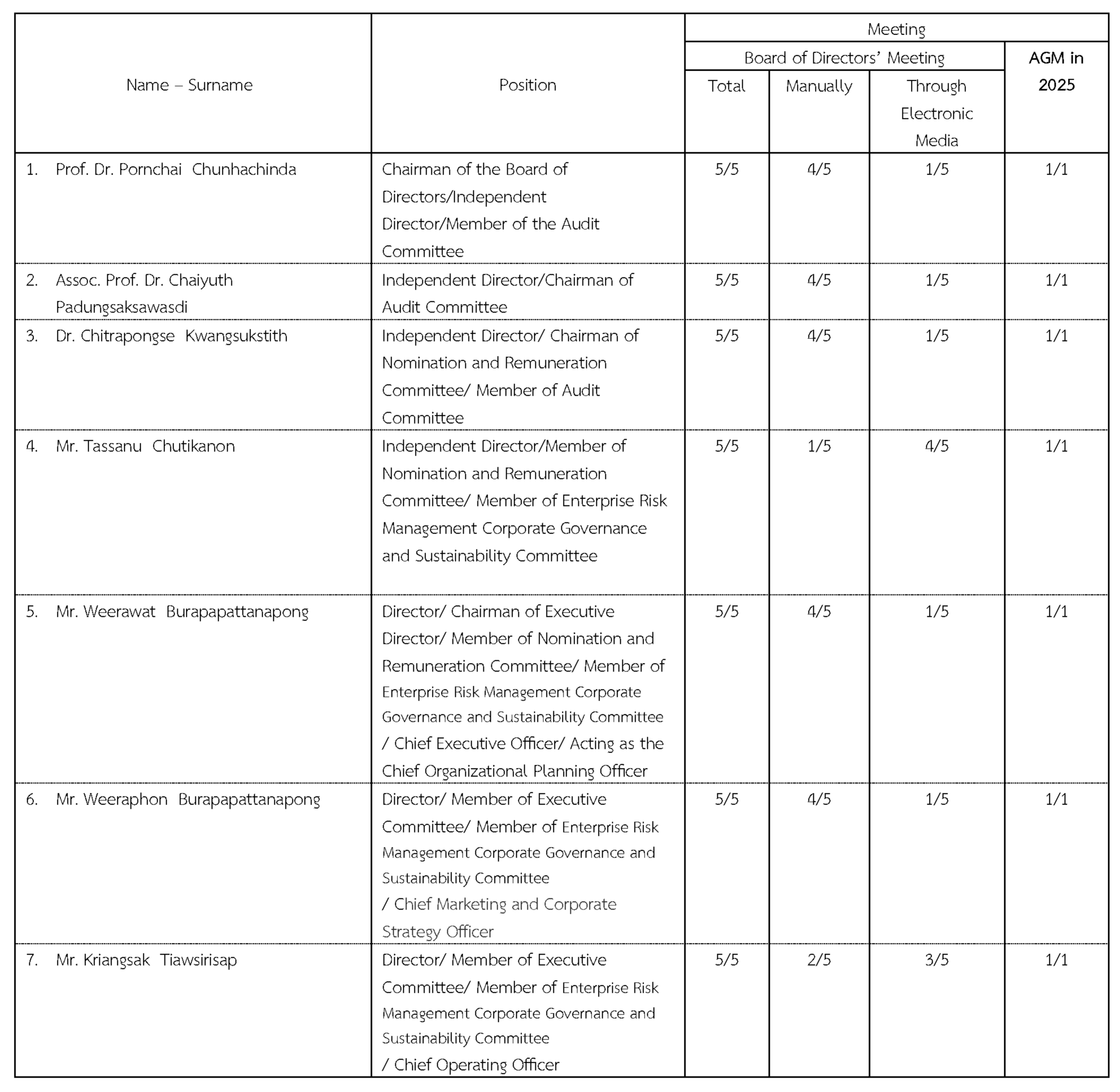
The number of Board of Directors meetings is consistent with the duties and responsibilities of the Board of Directors. In 2025, the Board of Directors held a total of 5 meetings. The information on attendance and remuneration paid to each director is as follows:
Meeting Attendance — Sub-section Introduction
The Company has scheduled meetings for the Board of Directors and subcommittees in advance each year. The company secretary will include it as an agenda item for the directors to consider at the end of each year and send out a meeting schedule throughout the following year via e-mail so that directors can allocate their time and attend the meeting. Each director must attend at least 75 percent of all Board meetings held during the year.
The Company Secretary is responsible for organizing the meeting and sending the notice of meeting, meeting agenda, and meeting documents to the directors at least 7 days prior to the meeting date to allow the directors sufficient time to review the information before attending the meeting, unless there is an urgent need. Each director can request further information from the Company Secretary. The agenda will clearly state whether it is a matter of follow-up on operations, for information, for consideration, or for approval.
The quorum of the Board of Directors meeting must have no less than half of the total number of directors to be considered a quorum. The minimum number of quorum at the time the Board of Directors will vote at the meeting must have no less than 2 out of 3 of the total number of directors. The Chairman of the Board shall act as the chairman of the meeting. In the event that the Chairman of the Board is not present at the meeting or is unable to perform his duties, in the event that there is a Vice Chairman, the Vice Chairman shall be the chairman of the meeting. But if there is no Vice Chairman or if there is one but is not present at the meeting or is unable to perform his duties, the directors who attend the meeting shall elect one director to be the chairman of the meeting. The Board of Directors may invite subcommittees, management, external auditors, and the Company's internal auditors to attend the meeting as necessary and appropriate.
The voting system uses a majority vote, which is a resolution of the meeting. In the event that a majority vote cannot be reached, the Chairman of the Board may cast an additional vote to be the deciding vote. However, in the case of considering matters related to any director, the director who has an interest in such matters must abstain from voting on such matters.
The number of Board of Directors meetings is consistent with the duties and responsibilities of the Board of Directors. In the past year 2025, the Board of Directors held a total of 5 joint meetings. This is to encourage non-executive directors/independent directors to exchange ideas freely, suggest various guidelines in the management of the company without the management. The company secretary has conveyed the opinions received from the meeting to the management for acknowledgement at the Executive Committee meeting for further implementation. The information on attendance and compensation paid to individual directors is as follows.
Meeting Attendance — Remark
Types of Remuneration of the Board of Directors
Board of Directors' Remuneration
a. Cash compensation
The Company has established remuneration for directors and executives at an appropriate level and at a rate sufficient to retain qualified directors and executives without excessive compensation and at a level comparable to companies in the same industry. At the 2025 Annual General Meeting of Shareholders held on April 25, 2025, the remuneration for the Board of Directors and subcommittees was set as a payment of directors' attendance fees per meeting, with details as follows:
Remuneration of the Board of Directors
Remuneration or Benefits Payable to the Board
| Metric | Amount (Baht) |
|---|---|
| Remunerations or benefits pending payment to the board of directors over the past year (baht) | 0 |
Supervision of Subsidiaries & Associated Companies
Supervision of Subsidiaries — Introduction
To enable Premier Tank Corporation Public Company Limited (the “Company”) to expand its business for stable and sustainable growth in the long term, to be able to control and oversee the business and operations of its subsidiaries as if they were one of the Company's departments, and/or to be able to effectively monitor the business operations of its associated companies, the Company has established the following investment and supervision policies for its subsidiaries and associated companies:
1. Investment
The Company's policy is to invest in subsidiaries and associated companies that have the potential to grow and generate good returns on investment, which may be businesses that support the Company's core business or other businesses with future prospects. Such investments must be consistent with the Company's business conditions, strategic plan, and the rules and regulations of the relevant regulatory authorities.
The Company will focus on long-term investments, considering the fundamentals and trends of the businesses in which it invests, and will invest in a significant enough proportion to enable it to participate in the management and direction of the subsidiaries and associated companies, as well as to promote the sustainable growth of the businesses in which it invests.
The Company will consider investments with caution and due diligence by conducting feasibility studies of the investment plan, taking into account risks, returns, the Company's financial liquidity, and the country's economic conditions. The investment plan will be submitted to the Board of Directors for approval. The Company will establish a system to monitor, follow up, and report on investments to the Board of Directors on a regular basis.
2. Supervision of Subsidiaries and Associated Companies
Premier Tank Corporation Public Company Limited (the “Company”) has a policy of supervising the operations of its subsidiaries and associated companies. Therefore, the nomination and exercise of voting rights in appointing directors of subsidiaries and associated companies must be approved by the Company's Board of Directors. The persons appointed as directors of subsidiaries or associated companies have a duty to act in the best interests of such subsidiaries or associated companies (not in the best interests of the Company). The Company requires that such appointed persons must obtain approval from the Company's Board of Directors before voting or exercising their voting rights on material matters of the subsidiaries and associated companies, which are of the same level of significance as if they were undertaken by the Company itself and would require the approval of the Company's Board of Directors. The appointment of representatives to serve as directors of such subsidiaries and associated companies shall be in accordance with the Company's shareholding proportion and/or the agreements between the shareholders of such subsidiaries and associated companies.
In addition, in the case of subsidiaries, the Company requires that the person appointed by the Company must ensure that the subsidiary complies with the regulations of the Office of the Securities and Exchange Commission and/or the Stock Exchange of Thailand regarding connected transactions, the acquisition or disposal of assets, or any other material transactions of such subsidiaries, and that the principles related to information disclosure and the aforementioned transactions are applied in the same manner as the Company's principles. The appointed person must also ensure that the subsidiary's data and accounting records are maintained in a manner that allows the Company to audit and consolidate them in order to prepare consolidated financial statements within the timeframe stipulated by the Stock Exchange of Thailand.
Does the Company Have Subsidiaries or Associated Companies?
Yes
Is There a Mechanism for Overseeing Subsidiaries and Associated Companies?
Yes
Mechanism for Overseeing Management of Subsidiaries
In order to protect the interests of the Company, the Company has established a policy for the governance of subsidiaries and associated companies, both directly and indirectly, along with measures to monitor the management of subsidiaries and associated companies, as follows:
1. The Board of Directors shall appoint or nominate persons to be appointed as directors of the subsidiary at least in proportion to the shareholding in such subsidiary, unless there are other legal restrictions or other circumstances as prescribed by the Securities and Exchange Act, the Notification of the Capital Market Supervisory Board, or the regulations of the Stock Exchange of Thailand, to act as representatives in managing the business, setting important policies, and overseeing the business operations of such subsidiaries in accordance with the established policies. The appointment of representatives to the board of directors of associated companies shall be in accordance with the investment agreement in such associated companies. The appointment of the Company's representatives as directors of each subsidiary and associated company must be considered and approved by the Board of Directors, taking into account the appropriateness of each company.
2. The Board of Directors shall oversee the directors of the subsidiary and/or associated company to ensure that they perform their duties and responsibilities in accordance with the law, regulations, and policies of the Company. The Board of Directors shall also ensure that the directors of the subsidiary and/or associated company appointed by the Company attend and vote at meetings of the board of directors of the subsidiary and/or associated company in considering any agenda items that are material to the business operations of the subsidiary and/or associated company.
3. The directors appointed by the Company shall exercise their discretion in voting at meetings of the board of directors of the subsidiary and/or associated company on matters relating to the general management and ordinary course of business of the subsidiary and/or associated company (as the case may be), unless such matters require the approval of the Board of Directors and/or the shareholders' meeting of the Company prior to proceeding, as follows:
3.1 In the event that a subsidiary enters into a transaction with a connected person of the Company or the subsidiary, or a transaction relating to the acquisition or disposal of assets of the subsidiary, where the size of the transaction, when calculated in comparison to the nature and/or size of the Company (using the criteria for calculating the size of the transaction as prescribed in the Notification on Connected Transactions or the Notification on the Acquisition or Disposal of Assets (as the case may be)), falls within the threshold requiring approval from the Board of Directors and/or shareholders of the Company, or approval from relevant authorities under the law prior to entering into the transaction, the subsidiary may only proceed with such transaction or action upon obtaining approval from the Board of Directors and/or the shareholders' meeting of the Company and/or relevant authorities (as the case may be).
3.2 Amending the Articles of Association of the subsidiary in matters that may have a material impact on the financial position and operating results of the subsidiary, including but not limited to amending the Articles of Association of the subsidiary that affect the Company's voting rights at meetings of the board of directors of the subsidiary and/or shareholders' meetings of the subsidiary, or the payment of dividends by the subsidiary.
3.3 If entering into a transaction would have a material impact on the financial position and operating results of the subsidiary, the directors appointed by the Company to hold positions in the subsidiary shall, before voting on the following matters, obtain approval from the Board of Directors on such matters:
(a) The transfer or waiver of benefits, including the waiver of claims against persons who have caused damage to the subsidiary.
(b) The sale or transfer of all or a material part of the business of the subsidiary to another person.
(c) The acquisition or transfer of the business of another company to become a subsidiary.
(i) Entering into, amending, or terminating an agreement for the lease of all or a material part of the business of the subsidiary, or assigning another person to
Managing the business of the subsidiary or merging the subsidiary with another person for the purpose of profit sharing.
(g) The lease of all or any material part of the business or assets of the subsidiary, or the lease of the business or assets to the subsidiary.
(f) The liquidation of the subsidiary.
(h) Borrowing, lending, granting loans, providing guarantees, entering into binding transactions that would increase the financial burden of the subsidiary, or
Providing other financial assistance to other persons in a significant amount that is not in the ordinary course of business of the subsidiary.
(j) Capital increase by issuing new shares of the subsidiary or share allocation, including the reduction of registered capital and/or paid-up capital of the
The subsidiary, which is not in accordance with the original shareholding proportion of the shareholders, or any other action that would result in a change in the proportion of voting rights
The Company's voting rights, both direct and indirect, at the shareholders' meeting of the subsidiary, in any round, are reduced by more than 10%.
of the total voting rights of such subsidiary.
(k) Any other transaction that is not in the ordinary course of business of the subsidiary and has a material impact on the subsidiary.
4. The representatives appointed by the Company to the board of directors of the subsidiary shall have the following duties:
4.1 Disclose information regarding the financial position and operating results, intercompany transactions between the Company and its subsidiaries, as well as the acquisition or disposal of significant assets, to the Company completely, accurately, and within a reasonable timeframe as determined by the Company.
4.2 Disclose and submit to the Board of Directors, within the timeframe specified by the Company, information regarding their own interests, both direct and indirect, and those of their related persons, in any transactions with other businesses that may be reasonably expected to give rise to any other conflict of interest with the Company and its subsidiaries. This information will be used by the Board of Directors in considering and making decisions or granting any approvals, with the primary consideration being the overall benefit of the Company and its subsidiaries.
The directors of the subsidiary appointed by the Company as mentioned above must not participate in approving matters in which they have a conflict of interest.
Provided that, the following acts, which result in a director appointed by the Company, or a person connected with a director appointed by the Company, receiving a financial benefit other than what is normally entitled to, or causing damage to the subsidiary or the Company, shall be presumed to be acts that materially conflict with the interests of the subsidiary:
(a) Transactions between the subsidiary and a director appointed by the Company, or a person connected with a director appointed by the Company, which are not in accordance with the principles of connected transactions.
(b) The use of inside information of the Company and its subsidiaries, unless such information has already been disclosed to the public.
(c) The use of assets or business opportunities of the Company and its subsidiaries in a manner that violates the rules or general practices prescribed by the SEC.
4.3 Report business plans, business expansions, large investment projects, and joint ventures with other operators to the Company through monthly or quarterly performance reports, and clarify or submit supporting documents for consideration in such cases as requested by the Company.
4.4 Clarify and/or submit information or documents related to the operation or any other documents to the Company upon request, as appropriate.
4.5 Ensure that the subsidiary has appropriate, effective, and adequate internal control, risk management, and anti-fraud systems in place to ensure that the operations of the subsidiary comply with the Company's policies, laws, notifications, regulations, and relevant rules of the SEC, the Office of the Securities and Exchange Commission, and the Stock Exchange of Thailand. This includes establishing clear procedures to demonstrate that the subsidiary has adequate systems in place to continuously and reliably disclose material transactions in accordance with the prescribed rules, and providing channels for the Company's Board of Directors to access information from the subsidiary to effectively monitor its performance, financial position, transactions between the subsidiary and its directors, and material transactions of the subsidiary. In addition, a mechanism must be established to audit such systems in the subsidiary, allowing the Company's internal audit team and independent directors to directly access information, and reporting the results of such system audits to the Board of Directors to ensure that the subsidiary consistently operates in accordance with the established systems.
Oversight Mechanisms
| Mechanism |
|---|
| Sending representatives to act as directors, executives or controlling persons in proportion to shareholdings |
| Disclosure of financial information and operating results |
Board Duty Performance — Overview
Board Duty Performance — Overall Description
The Company has established a corporate governance policy under the regulations of the Stock Exchange of Thailand, including aligning it with the good corporate governance principles for listed companies 2007 (CG Code) issued by the Office of the Securities and Exchange Commission. This policy serves as a guideline for the Board of Directors, executives, and employees in conducting business. The Company also mandates an annual review of its policies and practices to adapt to changes that may arise from business operations, the environment, circumstances, or laws. Details are available on the Company's website at www.premiertankcorp.com under the Corporate Governance section.
The Board of Directors is responsible for overseeing the management to ensure that their work aligns with the established goals, strategies, and plans to maximize the Company's benefits.
In 2025, the Board of Directors reviewed the corporate governance policy, including monitoring compliance with the policy and best practices. The Board also communicated the corporate governance policy and practices to all employees through internal information systems. The Company has established policies, directions, and business strategies, including reviewing business objectives and financial and non-financial business plans. Additionally, the Board of Directors has considered and screened various plans, prioritizing the interests of shareholders and the Company.
Audit Committee Duty Performance
Results of the Audit Committee's Duty Performance in the Past Year
The Board of Directors of Premier Tank Corporation Public Company Limited ("the Company") appoints the Company's Audit Committee, which consists of 3 independent directors who are qualified individuals with experience in accounting, finance, business administration, and organizational management. They are therefore suitably qualified to perform the duty of reviewing the reliability of financial reports in accordance with the requirements of the Securities and Exchange Commission (SEC) and the Stock Exchange of Thailand (SET). The committee comprises Assoc. Prof. Dr. Chaiyuth Padungsaksawas as Chairman of the Audit Committee, Prof. Dr. Pornchai Chunhachinda, and Dr. Jittapong Kwangsuksatit as Audit Committee members. In 2025 (January 1, 2025 – December 31, 2025), the Audit Committee held a total of 5 meetings in the form of physical meetings, in accordance with the Company's regulations. The objectives focused on reviewing the adequacy and effectiveness of internal control systems, the efficiency of operations and risk management, the reliability of financial and management reports, compliance with relevant laws and regulations, and the safeguarding of assets of the Company and its subsidiaries.
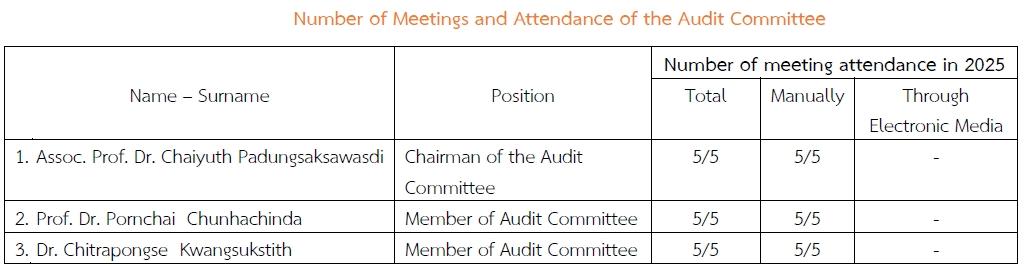
The Audit Committee performed its duties independently and fully in accordance with the Audit Committee Charter, as assigned by the Board of Directors. In 2025, the Audit Committee held one meeting agenda without the presence of executives, as part of other agenda items in Meeting No. 4/2025. This was a joint meeting between the Audit Committee, internal auditors, and certified public accountants to discuss and inquire with the auditors about the cooperation of the Company's operational departments in the audit and their independence from management's influence. The auditors clarified that they received full and sufficient cooperation from management in disclosing information and performed their work independently in auditing the Company's financial statements. The key aspects of their duties in 2025 are summarized as follows:
1. Review of financial reports. The Audit Committee reviewed significant information in the quarterly and annual financial reports for 2025 of the Company and its subsidiaries, in conjunction with management, internal auditors, and certified public accountants. This included reviewing issues related to significant accounting policies, changes over the past year, potential future impacts, and significant non-recurring items. The Committee is of the opinion that the financial reports accurately, completely, and reliably present the Company's financial position and operating results. The preparation of financial reports adheres to generally accepted accounting standards, with sufficient disclosure of information in the financial statements, and no items were found that could materially affect the financial statements.
2. Review that the Company has appropriate and effective internal control systems and internal audit systems. The Audit Committee considers and approves the annual internal audit plan for 2025, which is prepared by assessing risks and the adequacy of the internal control system to prioritize each system in line with the organization's objectives. It also provides recommendations for the internal audit unit's operations to achieve the planned objectives according to generally accepted standards. Furthermore, it approves the structure of the internal audit unit, the appointment and transfer of the head of the internal audit unit, and determines the appropriate staffing levels for the internal audit unit in accordance with the unit's mission and objectives as specified in the annual audit plan. It also evaluates the performance of the internal audit unit to guide improvements and development of audit work. Additionally, the Internal Audit Charter has been reviewed and revised to align with good and international best practices.
3. Review of internal controls related to good corporate governance and anti-corruption policy. The Audit Committee evaluated and reviewed the Company's internal control system for 2025 by preparing an assessment form for the adequacy of the internal control system, based on the assessment form of the Securities and Exchange Commission. The Committee is of the opinion that the system is appropriate and sufficiently effective for transparent business operations, with no significant issues found that could affect the implementation of the anti-corruption policy.
4. Review of risk management. The Audit Committee reviewed the policies and adherence to risk management principles of the Company and its subsidiaries to ensure that the Company has appropriate and effective risk management processes. This includes monitoring the assessment of potential risks arising from changing situations and business environments, comprising strategic risks, operational risks, administrative risks, financial risks, market risks, and corruption risks, and consistently implementing measures to mitigate or reduce risks in both the short and long term. The review found that risk management operations are sufficiently effective in accordance with the Company's policies and strategic plans.
5. Review of legal compliance. The Audit Committee reviewed and oversaw the Company and its subsidiaries' compliance with regulations, policies, and the conduct of various operations in accordance with securities and stock exchange laws, as per the requirements of the SEC and SET, and other laws relevant to the Company's business. No indications were found to suggest any deficiencies regarding non-compliance and/or practices that contradict or conflict with relevant requirements, regulations, and laws.
6. Considered appointing the Company’s auditors for 2025. The audit committee selected auditors by considering independence, skills, knowledge, experiences, performance, and audit fees of the Company; then, proposed to the board of directors forconsideration and to the shareholders’ meeting of 2025 for approval. The shareholders’ meeting approved and appointed Mrs.Suvimol Chrityakierne, certified public accountant No. 2982, or Ms. Somjintana Polhilunrat, certified public accountant No. 5599, or Ms. Kamolmett Chrityakierne No.10435, or Mr. Wirote Satjathamnkul No. 5128 from DIA International Auditing Company Limited as auditors to certify the financial reports for 2025 of the Company.
7. Review of connected transactions or transactions that may have conflicts of interest. The Audit Committee reviewed connected transactions that must comply with the law and the regulations of the Stock Exchange of Thailand (SET) regarding the disclosure of information and practices of listed companies in connected transactions B.E. 2546 (2003). The Audit Committee is of the opinion that the connected transactions were conducted under normal commercial terms, without conflicts of interest, were fair, reasonable, and fully complied with the criteria set by the SET. No unusual transactions were found, and information was disclosed completely and sufficiently.
8. Reporting of performance to the Board of Directors. The Audit Committee prepared a report on its performance along with the results of the financial statement review, submitting it to the Board of Directors once per quarter. It also prepared an Audit Committee report for disclosure in the annual report (January 1, 2025 – December 31, 2025) in accordance with SET regulations. In the past year, the Audit Committee did not find or suspect any events or circumstances indicating transactions or actions that could significantly impact the Company's financial position and operating results.
In summary for 2025, the Audit Committee performed its duties as stipulated in the Audit Committee Charter, monitoring the operations of the Company and its subsidiaries with sufficient independence. The Committee is of the opinion that the Company has prepared its financial reports accurately and reliably in all material respects, in accordance with generally accepted accounting standards, with sufficient disclosure of information. Furthermore, in entering into connected transactions or transactions that may have conflicts of interest, the Company has strictly complied with the law and SET regulations. It has also fully complied with laws, regulations, and rules related to business operations. Additionally, the Company has established adequate and appropriate risk management, effective and transparent corporate governance, and independent and qualified auditors and internal auditors who contribute to the robustness and effectiveness of the audit and internal control systems.
Executive Committee Duty Performance
Results of the Executive Committee's Duty Performance in the Past Year
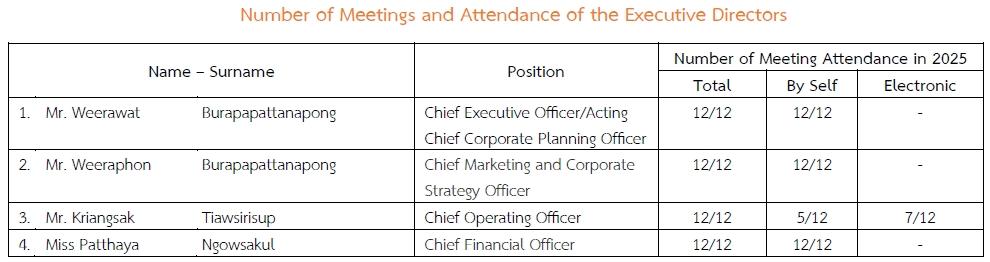
For the year 2025, the Executive Committee fully performed its duties in accordance with its charter, as assigned by the Board of Directors. The key aspects of its performance are summarized as follows:
1. Considers and provides initial opinions on the strategic management policies for the company's business operations, assesses the suitability of the business plan, and provides beneficial recommendations for organizational management and strategic implementation.
2. Considers and approves the annual budget before submitting it to the Board of Directors for consideration and approval, and continuously monitors performance monthly.
3. Serves to consider and approve the establishment and review of various company policies before submitting them to the Board of Directors for consideration and approval.
4. Considers and approves operations in accordance with company policies as assigned by the Board of Directors, as well as implementing various established procedures.
5. Reviews, inspects, and monitors the performance of all departments monthly to ensure compliance with the work plan and assignments from the Board of Directors.
6. Operates in accordance with normal business practices as specified in the approval authority and acts as authorized by the Board of Directors.
7. Reports the company's operating results to the Board of Directors quarterly, and presents the auditor's report on the company's financial statements, including annual and quarterly financial statements, at the meetings of the Audit Committee and the Board of Directors.
The Executive Committee performed its duties as assigned by the Board of Directors, utilizing its knowledge and capabilities with prudence, caution, and reasonableness to manage the business to achieve the company's vision, mission, goals, and strategies to its fullest potential, taking into account the best interests of the company, shareholders, and all stakeholders, in building confidence in the operations and overseeing the management of the company to be efficient and sustainable.