

CG Policy · 2025
In this section7 topics
Corporate Governance Policy
Sub-Section Introduction
The Company's Board of Directors has established a written Good Corporate Governance Policy, the content and key principles of which are consistent with the Corporate Governance Code for Listed Companies 2017 (CG Code) of the Securities and Exchange Commission, as well as the governance guidelines of relevant agencies. This policy has been disseminated to all directors, executives, and employees within the company through communications from the Human Resources Department and continuous public relations, to ensure that employees at all levels are aware of and adhere to it. Furthermore, the policy has been published for the company's shareholders and the general public on the company's website www.premiertankcorp.com, to allow shareholders, investors, and all stakeholders to study and be informed.
Has a Corporate Governance Policy
Yes
Policy Description
The Company believes that a sound management system, a visionary Board of Directors and executives who are accountable for their duties, along with control mechanisms, checks and balances, and corporate governance processes, are crucial and essential for sustainable business growth. These elements lead to the successful achievement of business goals and the organization's vision efficiently and effectively. Further information on the "Corporate Governance Policy" is available.
Policy Document Link
https://www.premiertankcorp.com/uploads/files/1763090595-pALQ5.pdf
Policy & Practices — Board of Directors
Introduction
The Board of Directors, acting as representatives of the shareholders, is responsible for overseeing the company's operations to ensure compliance with laws, objectives, regulations, and resolutions of the shareholders' meeting, as well as ensuring that management performs its duties to achieve the goals and strategies approved by the Board of Directors. Furthermore, it is responsible for monitoring operational performance according to the established plans, monitoring risk management, internal control, compliance with relevant regulations, and operational audits. To enhance the efficiency of the Board of Directors' performance, the Board of Directors has appointed four sub-committees, namely: the Audit Committee, the Nomination and Remuneration Committee, the Risk Management, Corporate Governance, and Sustainability Committee, and the Executive Committee. These committees comprise directors with diverse knowledge and expertise, and each committee's roles, duties, and responsibilities are clearly delineated.
Has Policy & Guidelines for the Board
Yes
Board Guidelines
| Guideline | Other — Please Specify | Detail |
|---|---|---|
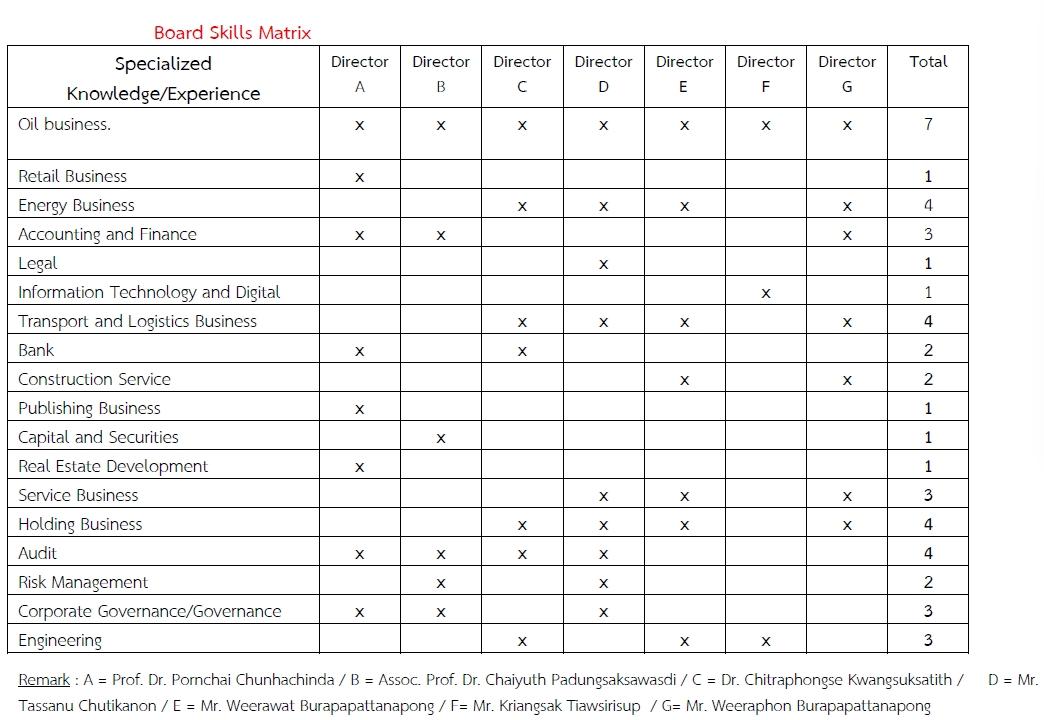
| Nomination of Directors | Nomination and Remuneration Policy The company has a nomination and remuneration policy for the selection of directors and senior executives. This policy outlines the principles, criteria, and methods for nominating individuals to serve as directors and senior executives, ensuring suitability with the company's specific characteristics, as well as selecting and proposing names to the Board of Directors for approval. (1) Nomination and Appointment of the Board of Directors Nomination of Directors The Board of Directors has appointed a Nomination and Remuneration Committee to nominate and screen suitable individuals for appointment as company directors. This is done by considering the appropriateness of the number, structure, and composition of the Board, as well as utilizing a reliable director database that compiles a list of qualified individuals from various fields. Subsequently, the Nomination and Remuneration Committee will consider the qualifications of the directors, without limitation or discrimination based on gender, race, religion, or any other differences, to propose to the Board of Directors and/or seek approval from the shareholders' meeting, as the case may be. In nominating new directors, the company will consider the composition in accordance with the nomination and remuneration policy and individually screen the qualifications of directors in various aspects to align with the company's business strategy, including utilizing a Director Pool database for the consideration of new director nominations. The company has granted shareholders the right to nominate suitable individuals for election as company directors, as announced on the company's website. However, no shareholder has nominated any individual for election as a company director. Composition of the Board of Directors The Board of Directors consists of a Chairman and directors, with a number appropriate to the size of the company's business and efficient operations. In total, there must be at least 5 directors, and at least one-third of the total number of directors must be independent directors, and not less than 3 persons. The Chairman of the Board must be an independent director. The company's directors are qualified individuals who meet all legal requirements and are not disqualified by law. The board structure is diverse in terms of knowledge, expertise, experience, and specific professional skills, to integrate knowledge and abilities for the benefit of the company's operations and business, without discrimination based on gender, age, race, nationality, religion, or any other differences. The Board of Directors has mandated the creation of a Board Skill Matrix to review and evaluate the current composition of the Board and to define the qualifications of directors to be nominated and appointed, in order to integrate beneficial knowledge and abilities for overseeing the company's business operations.
For the nomination of company directors, the Board of Directors assigns the Nomination and Remuneration Committee to identify qualified individuals to serve as directors in place of those whose terms have expired or in other cases, and to propose them to the Board of Directors and/or the shareholders' meeting for consideration and election. The nomination and selection of individuals suitable for proposal as company directors are summarized as follows: 1. A company director must be a natural person and of legal age. The selection of individuals to serve as company directors will be conducted through the Nomination and Remuneration Committee, which will consider and select based on the qualifications criteria under Section 68 of the Public Limited Company Act B.E. 2535 (1992) and the announcements of the Securities and Exchange Commission (Capital Market Supervisory Board Notification No. TorJ. 39/2559 Re: Application for and Approval of Offering Newly Issued Shares) and/or related laws. 2. The company's Board of Directors shall consist of at least 5 directors, and not less than half of the total number of directors must reside in the Kingdom. The company's directors must possess the qualifications prescribed by law. 3. The shareholders' meeting shall appoint directors by a majority vote according to the following criteria and methods: 3.1 One shareholder shall have one vote per share. 3.2 Shareholders shall cast votes for the election of directors individually. 3.3 The persons receiving the highest votes in descending order shall be elected as directors, up to the number of directors to be appointed or elected on that occasion. In the event that persons elected in the next descending order receive an equal number of votes exceeding the number to be appointed or elected on that occasion, the chairman shall cast the deciding vote. 4. At every Annual General Meeting, one-third of the directors shall retire from office. If the number of directors cannot be divided exactly into three parts, the number closest to one-third shall retire. For the first and second years after the company's registration, the directors to retire shall be determined by drawing lots. In subsequent years, the director who has been in office for the longest period shall retire. Retiring directors may be re-elected. 5. In the event that a director's position becomes vacant for reasons other than the expiration of their term, the Board of Directors shall select a person who possesses the qualifications and is not disqualified under the Public Limited Company Act and the Securities and Exchange Act to serve as a replacement director at the next Board meeting, unless the remaining term of that director is less than 2 months. The person appointed as a replacement director shall hold office only for the remaining term of the director they replace. The aforementioned resolution of the Board of Directors must be approved by no less than three-fourths of the votes of the remaining directors. 6. Any director wishing to resign shall submit a letter of resignation to the company. The resignation shall be effective from the date the letter of resignation reaches the company. (2) Nomination and Appointment of the Audit Committee Composition of the Audit Committee 1. Audit Committee members must be appointed by the Board of Directors or the shareholders' meeting, selected from independent directors. The Audit Committee must consist of at least 3 members. 2. The Audit Committee must include at least one person with sufficient knowledge, understanding, or experience in accounting or finance to be able to review the reliability of financial statements. 3. The Head of Internal Audit or a suitable person shall serve as the Secretary of the Audit Committee. The Audit Committee shall consider and appoint a suitable person to serve as the Secretary of the Audit Committee. 4. Tenure and Cessation of Office Tenure 1) The term of office for an Audit Committee member is 3 years per term. An Audit Committee member whose term has expired may be re-appointed. Cessation of Office 1) Completion of the director's term. An Audit Committee member whose term has expired may be re-appointed. In the event of re-appointment as a company director, that director shall continue to serve as an Audit Committee member for the remainder of their original term, according to the remaining tenure of that Audit Committee member. 2) Lacking qualifications to be an Audit Committee member according to the Audit Committee Charter, the Securities and Exchange Act, or the regulations of the Stock Exchange of Thailand and the Securities and Exchange Commission. 3) Resignation from the Audit Committee, by notifying the Chairman of the Board of Directors of the intention to resign at least 30 days in advance, along with the reasons, for the Board of Directors or the company's shareholders' meeting to consider appointing another qualified director as a replacement Audit Committee member. 4) Deceased If an Audit Committee member ceases to be an Audit Committee member before the completion of their term, the newly appointed Audit Committee member shall hold office for the remaining term of the Audit Committee member who vacated the position. Qualifications of the Audit Committee 1. Be an independent director with qualifications as prescribed by the SEC and/or the Stock Exchange (see details under the section on qualifications of independent directors). 2. Not be a director assigned by the Board to make decisions regarding the operations of the applicant, parent company, subsidiary, associate company, same-level subsidiary, major shareholder, or controlling person of the applicant, and not be a director of a parent company, subsidiary, or same-level subsidiary that is a listed company. 3. Have duties similar to those specified in the Stock Exchange of Thailand's announcement regarding the qualifications and scope of operations of the Audit Committee. 4. Possess sufficient knowledge and experience to perform duties as an Audit Committee member. At least one Audit Committee member must have sufficient knowledge and experience to review the reliability of financial statements. (3) Nomination and Appointment of Top Executives The Nomination and Remuneration Committee is responsible for considering and selecting individuals to hold the position of Chief Executive Officer, who will be selected to fill the vacant position, based on the following criteria: 1. Being a director of the company, in accordance with the company's articles of association. 2. Qualifications (a) Integrity and accountability (b) Informed judgment (c) Possess maturity and stability, be a good listener, and be able to express dissenting opinions independently. (d) Adhere to principled work. 3. Possess knowledge and ability in business operations, with skills, professional experience, and specific qualifications in various fields that are essential and most beneficial to the company's business. 4. Possess qualifications according to the criteria prescribed by the Securities and Exchange Commission and the Stock Exchange of Thailand. 5. Experience in the energy, petroleum, petrochemical businesses, and organizational management that will enhance the company's operational efficiency and competitive potential. 6. Experience as an organizational leader with strong leadership qualities. 7. Recognized by relevant business organizations. 8. Approved by the Board of Directors. | |
| Determination of Director Remuneration | Determination of remuneration for directors and executives The Board of Directors, upon the recommendation of the Nomination and Remuneration Committee, shall consider and approve the structure and rates of remuneration for directors as follows: 1) Consider appropriate forms and criteria for remuneration payment for directors and the Chief Executive Officer, to ensure that the forms and criteria for payment are appropriate. 2) Consider criteria for evaluating the performance of the Chief Executive Officer or Deputy Chief Executive Officer and propose them to the Board of Directors for approval. 4) Consider determining the annual remuneration of directors, taking into account the results of their performance evaluations, by including it as an agenda item and seeking approval from the Annual General Meeting of Shareholders. 5) Consider the terms and details for offering new securities or warrants to purchase shares to directors and employees (if any). | |
| Independence of the Board of Directors from the Management | Segregation of roles, duties, and responsibilities between the Board of Directors and management. The Company has segregated the roles, duties, and responsibilities between the Board of Directors and management. The Board of Directors has performed its duties with integrity, diligence, and care, safeguarding the Company's interests. Therefore, the Board of Directors' approval authority for various important matters has been clearly defined. with charters for the Board of Directors, sub-committees, Chairman of the Board, and Chief Executive Officer, which define the roles and operational duties of the Board of Directors, sub-committees, and management, ensuring collaboration and segregation of duties for operational clarity. Further information on the Board charters can be found in the attached document. | |
| Director Development | Development of Directors and Executives The company places importance on the development of directors and executives to promote their efficient development. This is stipulated in the Board of Directors' Charter, requiring directors to attend training courses related to their duties, organized by the Thai Institute of Directors (IOD) and other expert institutions. The Company Secretary will regularly present various training courses for the directors' consideration at the Board of Directors' meetings each year. Currently, 7 company directors, representing 100%, have attended training courses related to director duties, namely the Director Certification Program (DCP) and the Director Accreditation Program (DAP). Furthermore, the company regularly provides information on beneficial seminars and training to the Board of Directors. In 2025, other directors also participated in various seminars, such as independent directors attending the Independent Director Forum 2025 on the topic "Role of Independent Directors in Overseas Expansion and International Markets," and attending the seminar "Stronger together through the world of contradiction," among others. | |
| Board Performance Evaluation | Director Performance Evaluation The Board of Directors will arrange for a self-assessment of the Board and its sub-committees at least once a year for the past year, to allow all directors to evaluate their roles and effectiveness in management and the overall corporate governance of the Board. This is to comply with good corporate governance principles, with a focus on utilizing the evaluation results for improving the Board's performance and compiling information to inform the Board at its meeting in the following year. The evaluation forms include: 1. Board of Directors' overall performance evaluation form 2. Individual director performance evaluation form (self-assessment) 3. The performance evaluation form for each committee has evaluation criteria calculated as a percentage of the full score for each of the following topics: Score greater than 90% = Excellent Score greater than 80% = Very Good Score greater than 70% = Good Score greater than 60% = Fair Score less than 60% = Needs Improvement For the year 2025, the evaluation results conclude that the Board of Directors performed its duties in accordance with good corporate governance principles, with the following performance results: 1. Summary of the Board of Directors' self-assessment (collective) consists of 6 topics: Board structure and qualifications, Board roles, duties, and responsibilities, Board meetings, Board dynamics in performing duties, relationship with management, and director development. The evaluation results show an average score of 99.48%, categorized as "Excellent". 2. The individual director performance evaluation form (self-assessment) consists of 5 items: personal qualifications, readiness to perform duties, participation in meetings, roles, duties, and responsibilities, and relationships with the Board and management. The evaluation results show an average score of 99.70%, categorized as "Excellent". 3. Performance evaluation forms for each committee include: 1) The Audit Committee's evaluation results show an average score of 100.00%, categorized as "Excellent". 2) The Nomination and Remuneration Committee's evaluation results show an average score of 99.00%, categorized as "Excellent". 3) The Risk Management, Corporate Governance, and Sustainability Committee's evaluation results show an average score of 99.55%, categorized as "Excellent". 4) The Executive Committee's evaluation results show an average score of 99.48%, categorized as "Excellent". | |
| Corporate Governance of Subsidiaries and Associated Companies | The Company has a policy for supervising the operations of its subsidiaries and associated companies. Therefore, the nomination and exercise of voting rights for the appointment of individuals as directors in subsidiaries and associated companies must first receive approval from the Company's Board of Directors. Individuals appointed as directors in subsidiaries or associated companies are obligated to act in the best interests of those specific subsidiaries or associated companies (and not solely in the best interests of the Company). Furthermore, the Company requires that such appointed individuals must obtain approval from the Company's Board of Directors before casting votes or exercising voting rights on significant matters of the subsidiaries and associated companies, which are of a similar level of importance as matters that would require approval from the Company's Board of Directors if undertaken by the Company itself. The appointment of representatives as directors in the aforementioned subsidiaries and associated companies shall be in accordance with the Company's shareholding proportion and/or the shareholders' agreement in those subsidiaries and associated companies. Additionally, in the case of a subsidiary, the Company stipulates that individuals appointed by the Company must ensure that the subsidiary's operations concerning connected transactions, the acquisition or disposal of assets, or any other significant transactions of the said subsidiary are conducted completely and correctly in accordance with the criteria of the Securities and Exchange Commission and/or the Stock Exchange of Thailand. They must also apply the criteria related to disclosure and the aforementioned transactions in the same manner as the Company's criteria. This includes overseeing the storage of data and the recording of accounting information of the subsidiary, enabling the Company to inspect and compile it to prepare consolidated financial statements in a timely manner as stipulated by the Stock Exchange of Thailand. | |
| Other guidelines regarding the board of directors | Succession Policy | Succession Policy The company prioritizes continuous and sustainable business operations, thus it has established a critical succession plan to ensure continuity in management for executives at the Chief Officer level. This plan focuses on managerial employees, enabling the Human Resources Department to systematically prepare personnel with appropriate capabilities and potential, as well as accumulate the necessary experience for holding key positions within the company. Succession Planning Process as follows: Chief Executive Officer Level Should the Chief Executive Officer position become vacant or the incumbent be unable to perform duties, the company's policy is to appoint a nearby executive or a subordinate executive to serve as acting CEO until a person with vision, knowledge, skills, experience, and suitability for the organizational culture is found, or to propose selected successors to the Nomination and Remuneration Committee. The Nomination and Remuneration Committee shall define the qualifications and conduct the search to propose candidates to the Board of Directors for consideration and appointment. Executive Level Should an executive position, from the Chief Officer level upwards, become vacant or the incumbent be unable to perform duties, selected successors will be proposed to the Nomination and Remuneration Committee for consideration. The company's succession planning for the Chief Executive Officer and executive levels is as follows: 1. Analyze the business operating situation and assess the company's human resource readiness. 2. Define executive positions requiring succession plans, comprising the Chief Executive Officer and Chief Officers of each business line. 3. The Nomination and Remuneration Committee considers and defines the required knowledge, skills, and experience (Competency) and their levels for the Chief Executive Officer, while the Executive Committee will consider and define the required knowledge, skills, and experience (Competency) and their levels for each senior executive position. 4. The Nomination and Remuneration Committee considers and identifies suitable candidates qualified to succeed the Chief Executive Officer, and the Executive Committee will consider and identify suitable candidates qualified to succeed each senior executive position as follows: 4.1 Identify and position executives in each business line who are qualified and ready for succession immediately or within 1 year. 4.2 Identify and position executives in each business line who are qualified and ready for succession within a period of more than 1 year. 5. Assign the Chief Executive Officer to evaluate the performance and competencies of executives qualified to be selected as Chief Executive Officer and senior executives against the required competency levels, in order to develop individual development plans to reduce competency gaps. 6. The Chief Executive Officer periodically reports the performance and development results according to the individual development plans of executives qualified to be selected as Chief Executive Officer and senior executives to the Nomination and Remuneration Committee. Such reports must be submitted at least once a year. 7. The Nomination and Remuneration Committee reviews and summarizes the results of the succession plans for the Chief Executive Officer and senior executives annually and reports them to the Board of Directors for acknowledgment. In 2025, the Nomination and Remuneration Committee presented the results of the CEO succession plan implementation to the Board of Directors at the Board of Directors Meeting No. 4/2025 on November 13, 2025. |
Code of Conduct
Has a Business Code of Conduct
Yes
Code of Conduct Description
Premier Tank Corporation Public Company Limited and its subsidiaries ("the Company") are committed to conducting business ethically, managing with transparency, accountability, social and environmental responsibility, and treating all stakeholders equally and fairly, in accordance with good corporate governance policies for stable and sustainable growth. To establish a concrete standard for the company's business operations, a written Code of Business Conduct has been developed to serve as a guideline for all directors, executives, and employees of the company to conduct business in a standardized manner within the framework of ethics, morality, integrity, and respect for human rights. The company requires directors, executives, and employees at all levels to prioritize and adhere to their assigned duties with responsibility, treating all stakeholder groups equally and fairly, to achieve the organization's vision, create long-term value, and ensure continuous and sustainable growth.
Respect for and compliance with relevant laws, regulations, rules, and requirements.
1. Directors, executives, and employees of the company must comply with the laws, regulations, rules, and requirements of the Stock Exchange of Thailand and the Securities and Exchange Commission.
2. Directors, executives, and employees of the company must comply with relevant domestic and/or international laws, regulations, and requirements.
3. Directors, executives, and employees of the company must comply with the good corporate governance policy and the company's business code of conduct.
4. Directors and executives are required to review compliance with laws, regulations, and company rules, as well as promote and support consistent adherence.
5. Subsidiaries or business representatives of the company over which the company has control, as well as the company's business partners, must agree to comply with the company's business code of conduct.
In 2025, the Board of Directors approved the annual review of business ethics and codes of conduct at the Board of Directors Meeting No. 3/2025 on August 14, 2025. This was communicated to all directors, executives, and employees, who acknowledged and signed it 100%. No cases of misconduct by the company's directors, executives, or employees regarding the organization's ethics and code of conduct were found.
Code of Conduct Practices
| Guideline | Other — Please Specify | Detail |
|---|---|---|
| Prevention of Misuse of Inside Information | The company recognizes the importance of conducting business with integrity, transparency, and accountability, which are principles of good corporate governance and enhance organizational efficiency. Therefore, the company has established a policy requiring directors, executives, and employees to avoid any actions that may conflict with the company's interests. Such conflicts may arise from interactions with the company's business partners, such as customers, suppliers, etc., the use of company opportunities or inside information for personal gain, transactions with the company, engaging in businesses that compete with the company, etc., all of which could result in a loss of benefit for the company. In cases where such transactions are necessary and unavoidable, the company will ensure that these transactions are conducted with transparency, fairness, and as if they were with an independent third party, considering the company's best interests and fairness to all involved parties. To prevent conflicts of interest, the company has established the following guidelines: • The company must not provide loans or guarantees to directors or to entities in which directors hold more than 50% of the shares, unless it is part of the company's welfare benefits. • Directors must not engage in businesses that compete with the company, unless approved by the shareholders' meeting prior to their appointment as directors. • Directors and executives must not use company opportunities or information to benefit themselves or others, including engaging in businesses that compete with the company or related businesses. • Directors and executives must not participate in meetings or abstain from voting on items related to themselves that may create a conflict of interest with the company. If it is necessary to do so for the benefit of the company, such transactions must be conducted as if they were with an independent third party (Arm’s Length Basis). • Directors must disclose their interests in various contracts entered into by the company to the company. • Directors and executives must prepare a conflict of interest disclosure report annually or when an event occurs. • Transactions such as the purchase or sale of assets, etc., between directors and the company must be reported to and approved by the Board of Directors in advance. • The consideration of conflict of interest matters and transactions that may involve conflicts of interest must always include independent directors participating in the meeting and deliberation. • Directors, executives, and personnel of the company who have access to inside information should avoid using inside information for their own benefit or improperly disclosing inside information for the benefit of others.
The Board of Directors, together with the Audit Committee, carefully oversees transactions that may involve a conflict of interest to verify the reasonableness and necessity of such conflict-of-interest transactions. Concurrently, the Board of Directors ensures that the company discloses information related to potential conflict-of-interest transactions to stakeholders and relevant units after approving such transactions.
In 2025, the Board of Directors reviewed the aforementioned policy at Meeting No. 3/2025 on August 14, 2025. The Company Secretary, in conjunction with the Human Resources Department, communicated to all directors, executives, and employees to review and understand the policy. 100% of all directors, executives, and employees signed an acknowledgment agreeing to comply with the policy. Furthermore, the company's directors and executives reported their interests and those of related parties to the company. No misconduct was found, nor were any tips or complaints received regarding conflicts of interest. These matters were presented to the Audit Committee and the Board of Directors for consideration at each meeting. Details are provided in the report under the heading "Related Party Transactions".
| |
| Anti-corruption | Anti-Corruption Policy "The company's directors, executives, and employees are prohibited from supporting or accepting any form of corruption, whether directly or indirectly benefiting themselves, their families, friends, or acquaintances, regardless of whether they are recipients, givers, or offerors of bribes, monetary or non-monetary, to individuals, government officials, government agencies, or private entities with whom the company conducts business or has contact. This prohibition extends to the businesses of subsidiaries, joint ventures, or other companies over which the company has control, under any circumstances. Strict adherence to anti-corruption measures is required, including establishing responsible structures and systems for risk management, internal control, and internal audit to prevent and suppress corruption within the organization, as well as reviewing operational guidelines and requirements to align with changes in business, regulations, and legal provisions." Policy Scope This Anti-Corruption Policy and Guidelines cover the operations of the company, its subsidiaries, and controlled entities. It applies to the Board of Directors, executives, and employees at all levels, including authorized representatives acting on behalf of the company where the company has control. Furthermore, it aims for business partners or individuals involved in the company's business operations to support the implementation of this policy. This Policy and Guidelines have been established to provide guidance on what should be practiced or to identify who can provide consultation in case of doubt. The company's personnel are obligated to maintain the highest standards in business operations. Non-compliance with this policy constitutes a serious disciplinary offense, a breach of contract, and a criminal offense for the individual, and may cause severe damage to the company's reputation and status. The company has established guidelines, measures, and responsibilities for those in charge, as well as ensuring regular review and revision of compliance with this anti-corruption policy to align with changes in business, regulations, and legal requirements. Guidelines for Anti-Corruption Practices 1. Directors, executives, and employees at all levels must comply with the Anti-Corruption Policy, the Business Code of Conduct, and all related policies and guidelines, as well as relevant anti-corruption laws. They must not engage in any acts that constitute corruption, whether directly or indirectly, for their own benefit and/or the benefit of related parties. 2. All employees must not neglect or ignore any acts that constitute corruption related to the company and its subsidiaries. They must report such acts to their supervisor or through the channels specified in the company's whistleblowing and complaint policy, and cooperate in factual investigations. In case of doubts or questions, they should consult their supervisor or the designated responsible person. 3. The company will ensure fairness and protection for employees who refuse or report corruption related to the company. The company has clearly defined measures for protecting whistleblowers and complainants, and will not blame, take unfair action, demote, punish, or impose negative consequences on employees who refuse corruption, even if such refusal results in the company losing business opportunities. 4. Directors, executives, and employees at all levels who commit acts of corruption are considered to have violated the company's code of ethics and will be subject to disciplinary action in accordance with the company's regulations. Furthermore, they may face legal penalties if their actions are unlawful. 5. Anti-corruption measures are an integral part of business operations and are the responsibility of the Board of Directors, executives, supervisors, all employees at every level, suppliers, and subcontractors, who are expected to contribute their opinions on practices to ensure that anti-corruption efforts achieve the stated policy objectives. 6. Develop an anti-corruption system in compliance with relevant laws, establish appropriate and sufficient internal control systems, including conducting risk assessments for activities related to or susceptible to corruption, and define clear measures and guidelines for employees and relevant parties. 7. Foster an anti-corruption culture, promote awareness of operating with integrity and transparency, and provide communication and training to enhance employees' knowledge and understanding within the organization. Communicate and build understanding to support anti-corruption efforts with business partners, customers, and stakeholders, as well as disclose information to the public. 8. The company promotes communication through multiple channels to provide employees and stakeholders with convenient and secure means to report tips or concerns. The company guarantees that whistleblowers will have their rights protected, will not be punished, unfairly transferred, or harassed in any way. Additionally, responsible persons are appointed to transparently and fairly investigate and follow up on all reported cases. 9. The company provides anti-corruption training to the Board of Directors, executives, and employees at all levels to foster integrity, accountability in performing duties, and raise awareness of the company's commitment to transparent business operations. The company establishes mechanisms for accurate, transparent, and auditable financial reporting, while also emphasizing the dissemination of knowledge and fostering understanding among personnel involved in operations or activities that may affect the company, to ensure that all parties comply correctly with established standards. In 2025, 100% of the company's employees signed to acknowledge and comply with the Anti-Corruption Policy, which was reviewed and approved by the Board of Directors on August 14, 2025. The company conducts an annual assessment of corruption-related risks within the company. The Risk Management Working Group is responsible for compiling and submitting these assessments for initial consideration by the Risk Management Committee, then presenting them to the Audit Committee for review, and subsequently to the Board of Directors for acknowledgment. The company believes that factors leading to corruption can be controlled through robust internal control processes, effective workflow management, clear segregation of duties, and well-defined organizational structures. In 2025, the company did not find and did not receive any complaints or reports regarding misconduct related to the company's corruption. The company prioritizes conducting business with caution regarding corruption, adhering to good corporate governance principles for the utmost benefit of shareholders, stakeholders, and related parties. Therefore, an anti-corruption policy has been established to serve as a guideline, requiring executives and employees at all levels to comply with the prescribed procedures. In 2025, the company demonstrated its commitment to anti-corruption efforts to the Board of Directors as follows: • Reviewed the Anti-Corruption Policy at the Board of Directors Meeting No. 3/2025 on August 14, 2025. • Provided knowledge to new employees through orientation training on the topic of ethical compliance. In 2025, 46 participants attended the training. In 2025, there were no whistleblowing reports or complaints, and no individuals were found to have committed corruption. | |
| Whistleblowing and Protection of Whistleblowers | The company places importance on conducting business with caution regarding corruption, adhering to the principles of good corporate governance for the utmost benefit of shareholders, stakeholders, and related parties. Therefore, a whistleblowing and complaint policy has been established as a guideline, providing channels for all stakeholders to report abnormal information within the organization or submit complaints when they suspect, believe, or have reasonable grounds to believe in good faith that there are dishonest or non-transparent actions, or violations of good practices concerning 1) the company's policies, regulations, rules, or various criteria, 2) good corporate governance, code of conduct and ethics, and 3) laws or official requirements. Whistleblowing or complaints can be made through the following channels: 1) Suggestion and complaint box within the company 2) Whistleblowing and direct complaints to 2.1 Supervisors at all levels whom one trusts 2.2 Human Resources Department 2.3 Company Secretary 2.4 Audit Committee Member 2.5 Company Directors 3) Email 3.1 Chairman of the Audit Committee: whistle_blowing@premiertankcorp.com 3.2 Internal Audit Department: internal_audit@premiertankcorp.com 3.3 Company Secretary: company_secretary@premiertankcorp.com 4) Via the company's website www.premiertankcorp.com 5) By mail: Directly to the Chairman of the Board or the Chairman of the Audit Committee Premier Tank Corporation Public Company Limited 2034/69 Italthai Tower, 15th Floor, New Petchburi Road, Bang Kapi Subdistrict, Huai Khwang District, Bangkok 10310 The company has disclosed the process for protecting whistleblowers or complainants and the complaint channels on its website at https://www.premiertankcorp.com/complaints
In 2025, there were no complaints regarding the company's operations, actions, policies, regulations, rules, or various criteria, good corporate governance, code of conduct and ethics, and laws or official requirements.
| |
| Preventing the Misuse of Inside Information | The company has strict regulations and criteria for controlling and using inside information, especially financial position data, which must be audited/reviewed by certified public accountants and approved by the Audit Committee meeting every time before being submitted for approval to the Board of Directors and forwarded to the Stock Exchange of Thailand or disclosed to the public. The company has policies and procedures for managing the use of the company's inside information for personal gain, as follows: 1) Educate directors and various department executives about their duty to report their holdings of securities or derivatives, as well as those of persons related to directors and executives, to the Securities and Exchange Commission and the Stock Exchange of Thailand, in accordance with Section 59 and the penalties stipulated in Section 275 of the Securities and Exchange Act B.E. 2535. Persons related to directors and executives, as defined by the SEC Notification No. SorJor. 38/2561, are as follows: (1) Spouse or cohabiting partner as husband and wife (2) Minor children. (3) A legal entity in which oneself, persons under (1), and persons under (2) collectively hold more than 30% of the total voting rights of such legal entity, and such collective shareholding constitutes the largest proportion in that legal entity. 2) Directors, executives, including management-level positions in accounting or finance at the level of department manager or equivalent, are required to prepare and submit the following reports to the Company Secretary before submitting such reports to the Securities and Exchange Commission every time. 2.1) Report their own securities holdings in the company, securities holdings of spouses and minor children, including legal entities in which such individuals collectively hold more than 30% of the total voting rights and have the largest proportion of shareholding in such legal entity. Such reports must be prepared and submitted within 7 business days from the date of buying, selling, transferring, or accepting the transfer of securities or derivatives, and after the company has notified the names of directors and executives according to the methods prescribed by the Securities and Exchange Commission. 2.2) Report changes in their own securities holdings in the company, and changes in securities holdings of spouses and minor children. Such reports must be prepared and submitted within 3 business days from the date of buying, selling, transferring, or accepting the transfer of securities or derivatives, and after the company has notified the names of directors and executives according to the methods prescribed by the Securities and Exchange Commission. 3) Directors, executives, employees, and staff of the company who have access to material inside information that may affect the price of securities are prohibited from using such inside information to buy, sell, transfer, or accept the transfer of securities or derivatives issued by the company before such information is widely disseminated to the general public, especially within 30 days prior to the public disclosure of the company's financial statements or price-sensitive information. Furthermore, after the information has been disclosed, such individuals are prohibited from buying, selling, transferring, or accepting the transfer of securities or derivatives issued by the company until the public who has received such information has had a reasonable time to evaluate the information (at least 24 hours from the date and time of disclosure). Those involved with inside information must not disclose it to others until it has been reported to the Stock Exchange of Thailand. 4) Directors, executives, company employees, and individuals involved with inside information are prohibited from disclosing or transmitting inside information or company secrets to unrelated persons, including family members, relatives, friends, etc. 5) The company prioritizes preventing the use of inside information for illicit gain, to diminish the company's benefits, or to create conflicts of interest, as stipulated in its corporate governance policy, code of conduct and work ethics, employment contracts, and work regulations. 6) The company prioritizes maintaining the confidentiality of customer information and does not use such information for the benefit of directors, executives, employees, and related parties, unless it is information required to be disclosed by law. 7) Information disclosure must be carried out by executives or company employees authorized to disclose it. General employees who are not authorized to disclose information, when asked to disclose information they are not responsible for, should advise the inquirer to contact the person responsible for disclosing that information to ensure accuracy and consistency. 8) Do not provide advice or guidance on the trading of the company's securities, unless it is related to duties assigned by the company. 9) The company prioritizes the security of information in its information systems by controlling and/or preventing unauthorized access to company data by external parties, and by defining access rights for employees at various levels according to their duties and responsibilities. 10) In cases where external parties are involved in ad-hoc work concerning information not yet disclosed to the public and currently under negotiation, which falls under the category of preserving inside information that may affect the company's securities prices, such individuals must sign a Confidentiality Agreement until the information is disclosed to the Stock Exchange and the SEC. The company imposes disciplinary penalties for violations involving the use of company inside information for personal gain, ranging from written warnings, wage deductions, temporary suspension without pay, or termination of employment. The penalty will be determined based on the intent and severity of the offense. To ensure compliance, the company has communicated and fostered understanding among directors, executives, and employees by assigning the Company Secretary and the Human Resources Department the responsibility of communicating via email to these individuals about the policy and guidelines for preventing the use of inside information annually. In 2568, the company undertook the following actions: • The Company Secretary notifies directors, executives, and designated persons of the blackout period for securities trading via the company's email 30 days prior to the disclosure of quarterly and annual financial statements, and 24 hours after the disclosure of financial statements. • Report the securities holdings of the Board of Directors, executives, and related persons to the Board of Directors quarterly. • The Company Secretary communicated through the Board of Directors Meeting No. 3/2568 on August 14, 2568, and the Human Resources Department communicated via email to employees within the organization to acknowledge the policy after the Board of Directors approved the annual review. Employees were required to sign an acknowledgment and agreement to comply with the policy, with 100.00% of directors, executives, and employees acknowledging it.
No directors, executives, or employees were found to have accessed inside information and violated the securities trading policy for directors, executives, and employees of the company.
| |
| Prevention of money laundering | The company adheres to and complies with principles, laws, and regulations related to anti-money laundering, stipulating that executives and employees at all levels are prohibited from receiving, transferring, converting assets, or supporting any actions related to the illegal acquisition of assets, to prevent the company from being used as a channel or tool for transferring, concealing, or disguising the origin of illegal assets. Guidelines
| |
| Giving or receiving gifts, entertainment, or business entertainment | The company requires all directors, executives, employees, and staff to refrain from soliciting or accepting gifts, entertainment, hospitality services, or any benefits that may influence business decisions or lead to neglect of duties, including actions that could be perceived as giving or receiving bribes, whether directly or indirectly, to individuals, government officials, state agencies, or private entities. The giving and receiving of gifts, entertainment, hospitality services, or any other benefits may be conducted provided they meet the following characteristics: 1. Conduct operations solely on behalf of the company in a correct, transparent, and open manner. 2. Not violate moral principles and comply with laws and company regulations. 3. Be appropriate for the situation, festivals, and customs. 4. Do not use any gifts or benefits to support acts that constitute fraud or corruption. 5. Have no impact on decisions related to the company's interests or create a conflict between personal and organizational interests. | |
| Compliance with laws, rules and regulations | The Board of Directors is committed to conducting business in accordance with the law. The Company's personnel are aware of their respective roles and responsibilities to comply with various laws, regulations, and rules, both internal and external to the organization. The Company has established various corporate policies approved by the Board of Directors, and new regulations are reviewed and monitored annually. Furthermore, operational procedures and manuals are in place, aiming to ensure that employees are aware of and adhere to various internal and external regulations. For compliance operations, the Company has engaged Audit House Co., Ltd. ("AUDIT"), which was assigned by Premier Tank Corporation Public Company Limited to act as the internal auditor. AUDIT therefore reviewed the Company's internal control system according to the internal audit project to evaluate the Company's internal control system. AUDIT is of the opinion that the Company has established an internal control system that is sufficient and appropriate for the nature and size of its business operations. Policies, procedures, scopes of responsibility, levels of management approval, and process control measures are clearly and rigorously documented to prevent fraud. Additionally, the Company has an internal audit department that periodically reviews the performance of its personnel. Regarding compliance operations, the practices can be divided into 4 types as follows: Related Laws The Company also recognizes the importance of complying with relevant laws that affect stakeholders. In accordance with the Personal Data Protection Act B.E. 2562 (2019), the Company has therefore developed separate Personal Data Protection Policies for external parties and business partners, and for employees. These policies are published on the Company's website to inform employees and external parties of the organization's intent regarding the handling of personal data, as well as to inform data owners of their various rights and to ensure their understanding of the purposes and methods of collecting, using, and disclosing personal data, among others. The Company also places importance on respecting and complying with relevant laws in all areas where it conducts business. The Board of Directors has stipulated compliance with relevant laws, regulations, rules, and guidelines in the Company's Code of Ethics and Conduct, which covers the Board of Directors, executives, and employees at all levels. They are required to understand and strictly adhere to laws related to the Company's business operations to ensure that the Company's operations are correct and efficient. Industry Standard Compliance 1. Quality Management System ISO 9001:2015 is an international standard that businesses worldwide prioritize for quality excellence and operational efficiency within the organization. The implementation of a quality assurance management system ensures that various processes are controlled and auditable through a system that specifies work procedures and methods. This ensures that personnel within the organization understand their duties, responsibilities, and operational steps. Training must be provided to impart knowledge and skills for operations, data must be recorded, and operations must be checked to ensure compliance with the system. Furthermore, errors must be corrected, and measures to prevent recurrence of previous errors must be established. 2. Occupational Health and Safety Management System ISO 45001:2018 is a standard that facilitates the implementation of an occupational health and safety management system by establishing a health and safety management system based on minimizing workplace risks and improving overall safety and working conditions. It enables the identification, analysis, and assessment of various risks that may affect employees, allowing for the development of methods or preventive measures to improve the working environment. 3. Environmental Management System ISO 14001:2015 is an international standard for an organization's environmental management system, aimed at enhancing internal environmental performance and environmental sustainability. It systematically manages environmental responsibilities by using the requirements specified in the environmental management system standard as a guideline for practice, to meet the expectations of the environmental management system. This includes improving environmental performance, ensuring compliance with relevant laws and obligations, and achieving the organization's own environmental management objectives, thereby creating value for the organization, stakeholders, the environment, and aligning with the organization's environmental policy, as well as promoting environmental sustainability. In 2025, the Company engaged a licensed company to conduct workplace environmental inspections, including quantifying chemical concentrations, measuring 8-hour average noise levels, measuring heat values in the establishment, measuring light intensity values in the establishment, measuring drinking water quality, and measuring wastewater quality. All items were found to be within standard criteria, with wastewater quality measurements meeting standard parameters, reflecting the Company's commitment to the environment and indicating adherence to its vision of "Sustainable and Caring Management Principles." This also aligns with the sustainable development goals as per "The 17 sustainable development goals (SDGs) to transform our world," specifically Goal 6: Clean Water and Sanitation. Accounting Standards The Company has prepared financial reports in accordance with the accounting standards prescribed by the Federation of Accounting Professions. Furthermore, the Company's auditor, DIA International Audit Co., Ltd., which audited the financial statements for the year 2025, stated in its audit report that the Company did not have any material deficiencies in its accounting system. The auditor's review of the 2025 annual financial statements found no risks or deficiencies in the internal control system, thus no Management Letter was prepared for 2025. Furthermore, the auditor reported the results of the 2025 financial statement audit to the Audit Committee, stating that no irregularities related to fraud were found that would materially affect the Company's financial statements. | |
| Use and maintenance of data and assets | Company Asset Preservation and Utilization Policy
Premier Tank Corporation Public Company Limited recognizes the importance of utilizing company assets, which are resources provided by the company for its business operations. Executives, employees, and relevant parties are responsible for utilizing company assets to their fullest potential and for controlling, supervising, and maintaining assets with due diligence. They shall not use company assets for their own benefit or the benefit of others, unless authorized by the approving authority. Company assets refer to tangible and intangible assets, both income-generating and non-income-generating, which have value and a useful life exceeding one year, such as movable and immovable properties, including technology, technical knowledge, proprietary information, rights, copyrights, patents, concessions, inventions, and intellectual property, among others. | |
| Cyber security | Use and Security Maintenance of Information Technology Systems The company prioritizes the appropriate and secure use of electronic data, information technology systems, network systems, and computers to ensure continuous company operations. Systems are used in compliance with regulations and laws concerning computer-related offenses, as well as to prevent threats that could cause damage to the company. All employees must adhere to policies and regulations, and are responsible for protecting information from unauthorized access or dissemination, by observing the following: 1. Electronic devices and electronic data are designated for the company's benefit. 2. It is prohibited to use any information technology to access inappropriate websites, and to avoid accessing illegal information or information that violates good morals, as well as not to disseminate internet information to others. 3. It is prohibited to use for one's personal business benefit or for other benefits related to politics or associates. 4. Employees must not unlawfully access computer systems that have specific access prevention measures, and where such measures are not intended for them. 5. Employees must not unlawfully access or become aware of specific computer system access prevention measures created by others without authorization, and are prohibited from disclosing or misusing such measures, which may cause damage to the company or other individuals. 6. It is prohibited to unlawfully intercept, by electronic means, data of others being transmitted within a computer system, where such computer data is not intended for public benefit. 7. It is prohibited to send computer data or electronic mail to others by concealing or falsifying the source of such data transmission, which disturbs the normal use of computers by others. 8. It is prohibited to commit any act that may cause damage to computer data or electronic systems related to national security, public safety, or any act against computer data intended for public benefit. 9. The company reserves the right to inspect the use of electronic devices, information systems, and electronic data provided by the company for employees' work, without prior permission from the user. Such inspections will be conducted strictly within the framework of laws, data security policies, and company regulations. Information Disclosure Aspect As a company listed on the Stock Exchange of Thailand since February 15, 2022, the company has prioritized full compliance with the Public Limited Company Act and the Securities and Exchange Act, as required by law. Furthermore, the company regularly sends relevant personnel to attend training on applicable laws essential for operations, to ensure employees gain knowledge, understanding, and can apply it to their work. Information disclosure is one of the important principles for good corporate governance. Therefore, the company emphasizes the accuracy, sufficiency, timeliness, and equality of information provided to all groups of stakeholders and the Stock Exchange of Thailand. The preparation of such information adheres to established guidelines, with the Investor Relations department and Company Secretary performing these duties. Company information includes financial and non-financial data. In 2025, the disclosure of financial statement information has been reviewed/audited by auditors to be materially correct according to generally accepted accounting principles and approved by the Audit Committee/Board of Directors before public disclosure. For non-financial information disclosure, the company has disclosed information according to the criteria set by the Stock Exchange and the SEC Office, which include related party transactions, dividend payments, management discussion and analysis, meeting invitation letters, and shareholder meeting minutes. Additionally, good corporate governance reports are included in the annual information statement, Form 56-1 One Report. Disclosure of Information and Transparency • The Board of Directors mandates the disclosure of important company-related information, both financial and non-financial, in accordance with the regulations of the Securities and Exchange Commission (SEC) and the Stock Exchange of Thailand, as well as other relevant information, accurately, completely, timely, and transparently. This ensures that investors and all stakeholders of the company receive information equally through various channels and methods, such as the Stock Exchange of Thailand's news system, Form 56-1 One Report, and the company's website. Additionally, a Company Secretary and Investor Relations personnel have been appointed to manage and store such information. • The company's financial audit is conducted by certified public accountants from D.I.A. International Audit Co., Ltd. The auditors are independent, knowledgeable, skilled, and certified by the Securities and Exchange Commission (SEC). During the audit, the Audit Committee received reports from the auditors confirming their independence, cooperation, and absence of any conflicts with management. Regarding the company's internal audit, the Board of Directors has approved Audit House Co., Ltd. to propose a plan and conduct an audit of the internal control system to ensure that the company has appropriate and effective management, supervision, control, and risk management systems. • The Board of Directors ensures the disclosure of the roles, duties, remuneration, and meeting attendance of the Board of Directors and sub-committees, itemized by individual, in the company's Form 56-1 One Report. The company participated in the Mai Forum 2025, organized by the Stock Exchange of Thailand, once on June 21, 2025, at Centara Grand at CentralWorld Hotel. • The Board of Directors has established an Investor Relations department to communicate and publicize information to various parties, including disclosing information about the company's business and performance to shareholders, individual and institutional investors, analysts, journalists, and the general public, accurately, completely, and timely. This also includes building confidence and enhancing the organization's positive image. Contact channels are: Tel: 02-318-4013 Fax: 02-318-4014 E-mail: investor_relation@premiertankcorp.com | |
| Environmental management | Environmental Dimension of Sustainability Management The Company prioritizes the development of environmental operations to comply with relevant laws, regulations, and international standards. The Company is committed to managing processes throughout the business value chain to ensure efficient resource utilization, along with managing to reduce environmental impact. Therefore, the Company has established the following guidelines for environmental conservation for sustainability: • Establish environmental policies and practices to comply with relevant laws and regulations concerning environmental management appropriately, by focusing on efficient service provision and reducing environmental impact, as well as maximizing the beneficial use of resources through circulation. • Instill awareness and campaign for all employees in the organization to recognize the importance of energy conservation, such as appropriate use of electricity and water, as well as supporting waste management through waste segregation, and initiating support for greenhouse gas management. • Establish systematic environmental management with oversight processes, monitoring and improvement processes, and evaluation and reporting for continuous development. • Communicate environmental policies and practices to all employees in the organization, as well as stakeholders throughout the value chain, with the Board of Directors and management committed to managing and supporting the Company's continuous implementation of these policies and achieving the established guidelines. Furthermore, the Company also prioritizes the safety and hygiene of its personnel by promoting and instilling awareness in safety, occupational health, and environment. The Company has established a policy on safety, occupational health, and working environment to ensure employees have a safe and hygienic working environment. | |
| Human rights | The company is committed to fairness and integrity with its stakeholders to build continuous good relationships in business operations. It also does not unfairly discriminate against anyone by using personal judgment or relationships, and provides equal opportunities without distinction of race, nationality, religion, or gender. Guidelines: • Directors, executives, and employees must ensure fairness and non-discrimination towards stakeholders in business operations. The provision of benefits to stakeholders should adhere to the company's principles and policies. • Directors, executives, and employees must manage operations with prudence and circumspection to build confidence among shareholders. Any decision to take action must be made fairly and with the utmost consideration for the best interests of all shareholders. • Directors, executives, and employees must ensure fairness and non-discrimination in employment terms, which include personnel recruitment, consideration of compensation and employment benefits, promotions, transfers, performance evaluations, training, compliance with rules and regulations, termination of employment, dismissal and re-hiring of employees, as well as participation in social and recreational activities, etc. • Directors, executives, and employees must provide services to customers with honesty and fairness, without exploiting or defrauding them. • Directors, executives, and employees must adhere to trade agreements or conditions with business partners and/or creditors honestly and fairly. In cases where conditions cannot be met, partners and/or creditors must be informed to jointly seek solutions. Respect for Human Rights and Fair Treatment of Labor Guidelines • Support and respect the protection of human rights by regularly monitoring and ensuring that their businesses are not involved in human rights violations. • Promote monitoring of compliance with human rights requirements within their businesses and encourage adherence to human rights principles according to international standards. The business's human rights responsibilities also extend to subsidiaries (if any), joint ventures, and business partners. • The company will treat all its personnel equally, without discrimination based on origin, race, gender, age, skin color, religion, physical ability, status, lineage, educational institution, or any other status not directly related to job performance. • The company provides opportunities for all its personnel to fully demonstrate their abilities by offering appropriate compensation and creating work incentives, including salaries, bonuses, and appropriate operational expenses in accordance with company regulations. Additionally, the company provides opportunities for its personnel to pursue further education and training, both short-term and long-term. • All company personnel must perform their duties and responsibilities to the best of their ability, with honesty, integrity, and adherence to moral principles. They must not delegate their duties to any individual, directly or indirectly, unless it is necessary or for the convenience and speed of tasks that do not require their specific expertise. • Company personnel must perform duties according to the chain of command, receive orders, and be directly responsible to their supervisors. They must not bypass the chain of command unless absolutely necessary. They should avoid criticizing supervisors and colleagues in a way that could cause damage to those individuals or to the company. Nevertheless, company personnel will provide opportunities and be open-minded to listen to the opinions of subordinates and colleagues with mindfulness, without prejudice, and with reason. • Company personnel may fully utilize company resources, labor, premises, and facilities for their duties. The use of company resources, labor, premises, and facilities for purposes other than official duties or legitimate benefits is prohibited. • Company personnel must maintain polite manners, dress appropriately for the occasion, and conduct themselves in a manner suitable for their duties and local customs, without damaging the company's image. • Company personnel may use their names and positions to solicit donations for charitable causes organized by the company, but they are prohibited from using the company's name and their company position to solicit funds privately, for any purpose whatsoever. • Company personnel should cooperate in activities organized by the company to foster unity and mutual support, as well as in social activities organized by the company. • Company personnel are prohibited from engaging in actions that cause distress, annoyance, demoralization of others, create hostility, or disrupt work, including sexual harassment towards company personnel or external parties conducting business. This includes sexual assault, flirtation, molestation, indecency, and the possession of obscene images, both verbally and physically. | |
| Occupational health and safety | The company has a policy regarding safety, occupational health, and the working environment, emphasizing the prevention of hazards to ensure that employees and the establishment are free from incidents that could cause occupational dangers. The company will care for its employees and arrange for the establishment to have safe and hygienic working conditions and environment, as well as promote and support employees' operations to be safe from hazards. Employees at all levels are responsible for cooperation and must strictly adhere to official laws, regulations, safety standards, and company policies and rules. They are also responsible for maintaining the working environment according to established standards to ensure the safety of life, body, mind, and health, taking into account the nature of the work and the areas of responsibility. The company is committed to implementing this. 1. To strictly comply with all stipulated laws, regulations, announcements, orders, and standards concerning safety, occupational health, and working environment. 2. To continuously support and promote safety, occupational health, and the working environment by allocating sufficient and appropriate budgets. 3. To promote safety by continuously providing training, knowledge, reviews, and drills, as well as organizing various activities to enhance safety awareness among employees and within the establishment, ensuring constant preparedness. 4. To prepare and provide personal protective equipment for employees to use or wear as appropriate for the nature of their work and operations. 5. To arrange for safety inspections and strictly enforce employee compliance with safety regulations, as well as to diligently supervise and ensure that employees wear and use protective equipment as strictly prescribed by the company. 6. To continuously elevate and develop the company's internal environment, workplace, and surrounding cleanliness to ensure safety, a good and hygienic environment, and a high quality of work life and health. 7. To emphasize employee cooperation in complying with regulations concerning safety, occupational health, and the environment, leading to successful accident prevention. 8. To ensure safety at work, as well as correct and safe operating procedures, is the duty and responsibility of employees and supervisors at all levels. 9. All employees are required to participate in preventing occupational hazards and maintaining a good environment. The company will accept suggestions and feedback from employees and consider appropriate revisions and improvements to various shortcomings to ensure safety and a good environment for employees. 10. In the event of an employee sustaining a work-related accident, the company will provide care and consider appropriate assistance to enable the injured employee to maintain a reasonable livelihood. | |
| Other guidelines related to business code of conduct | Information Disclosure and Transparency | • The Board of Directors mandates the disclosure of significant company-related information, including both financial and non-financial data, in accordance with the regulations of the Securities and Exchange Commission (SEC) and the Stock Exchange of Thailand, as well as other relevant information, accurately, completely, timely, and transparently. This ensures that investors and all stakeholders of the company receive information equally through various channels and methods, such as the news system of the Stock Exchange of Thailand, Form 56-1 One Report, and the company's website. Additionally, a Company Secretary and Investor Relations officer have been appointed to manage and store such information. • The company's accounts are audited by certified public accountants from D.I.A. International Audit Co., Ltd. The auditors are independent, knowledgeable, skilled, and certified by the Securities and Exchange Commission (SEC). In connection with this audit, the Audit Committee received a report from the auditors confirming their independence, cooperation, and absence of any conflicts with management. Regarding the company's internal audit, the Board of Directors approved Audit House Co., Ltd. to propose a plan and conduct an audit of the internal control system to ensure that the company has appropriate and effective management, oversight, control, and risk management systems. • The Board of Directors ensures the disclosure of the roles, duties, remuneration, and meeting attendance of the Board of Directors and sub-committees, itemized by individual, in the company's Form 56-1 One Report. • The Board of Directors has established an Investor Relations unit to communicate and publicize information to various parties, including disclosing accurate, complete, and timely information about the company's business and operating results to shareholders, individual and institutional investors, analysts, journalists, and the general public. This also includes building confidence and enhancing the organization's positive image. Contact channels are: Tel: 02-318-4013 Fax: 02-318-4014 E-mail: investor_relation@premiertankcorp.com |
Promoting Compliance with the Code of Conduct
Promotes Compliance by Directors, Executives and Employees
Yes
Description
The Company stipulates that it is the duty and responsibility of all directors, executives, and employees to acknowledge, understand, and strictly adhere to the established business ethics and codes of conduct. Executives within the organization must supervise and consider it a matter of utmost importance to ensure that employees under their command are aware of, understand, and seriously comply with the prescribed code of ethics.
Directors and executives at all levels within the organization must oversee and take responsibility, considering it a matter of utmost importance to ensure that employees under their command are aware of, understand, and seriously comply with the Company's Business Ethics Handbook.
The Company does not condone any actions that are illegal or contrary to good ethical principles. Should any director, executive, or employee violate the established ethics, they will be subject to strict disciplinary action. Furthermore, if there is any action believed to be in violation of laws, rules, regulations, and government ordinances, the Company will refer the matter to the relevant government authorities for further action.
Anti-Corruption Networks & Projects
Joined or Declared Intent to Join Anti-Corruption Networks
Yes
Networks & Projects Joined
| Network / Project | Network Name — Please Specify |
|---|---|
| Thai Private Sector Collective Action Against Corruption: CAC | |
| United Nations Global Compact (UNGC) | |
| Participation of anti-Corruption networks and initiatives | Project for Thai Private Sector Collective Action Against Corruption |
Material Changes & Developments in CG
Introduction
The Board of Directors has arranged for the continuous improvement of policies, practices, and good corporate governance systems to enhance the efficiency of corporate oversight and to elevate the company's corporate governance standards in line with the Principles of Good Corporate Governance for Listed Companies 2017 (Corporate Governance Code or CG Code) of the Securities and Exchange Commission, as follows:
Reviewed the CG Policy or Board Charter in the Past Year
Yes
Material Changes or Developments in the Past Year
Yes
Policy Review — Description
In 2025, the Board of Directors approved the review/amendment of policies, guidelines, and the good corporate governance system, as follows:
1. Approved the review of the company's good corporate governance policy, ethics and codes of conduct for work, as well as various company policies, to ensure their suitability with current situations and changes, and to regularly monitor compliance with policies and guidelines.
2. Approved the review of 23 annual company policies for 2025 to ensure their suitability with current situations and changes.
3. Approved the policy for supervising subsidiaries and associated companies to safeguard the company's interests.
Implements the CG Code for Listed Companies
Yes
CG Code — Description
Principle 1 Recognizing the role and responsibilities of the Board of Directors as organizational leaders who create sustainable value for activities.
1.1 Understanding the role and recognizing the responsibility as a leader to oversee good organizational management.
• The Board of Directors is responsible for considering and approving important company matters, including the vision, mission, values, organizational strategy, business plan, and significant investment items for the company. In the past year, at the 5th Board of Directors meeting of 2025, held on December 17, 2025, the company's vision, mission, operational goals, business strategies, and the 2026 annual business plan were reviewed.
• The Board of Directors reviews and approves the company's operational plans, which include the business plan, annual budget, and enterprise risk management plan.
• The Board of Directors monitors operational performance at least quarterly and evaluates results at the end of each year, requiring management to report at Board of Directors meetings.
In 2025, the Board of Directors approved the review/revision of policies, guidelines, and the good corporate governance system by:
1. Approve the review of the company's good corporate governance policy, ethics, and code of conduct, as well as various company policies, to ensure their suitability for current situations and changes, and to regularly monitor compliance with policies and guidelines.
2. Approve the review of 23 company policies for the year 2025 to ensure their suitability for current situations and changes.
1.2 Overseeing corporate governance to achieve at least the following results: (1) being competitive and having good performance, considering long-term impacts; (2) conducting business ethically, respecting rights, and being responsible to shareholders and stakeholders; (3) benefiting society and developing or reducing negative environmental impacts; (4) being adaptable to changing factors.
• The Board of Directors defines a mission that reflects the creation of sustainable value for the business.
• The Board of Directors acts as a role model in corporate governance, for example, by considering their own conflicts of interest.
• The Board of Directors has established written corporate governance policies, business ethics, and codes of conduct.
• The Board of Directors has assigned the Executive Committee to oversee good corporate governance and social, community, and environmental care (CSR).
1.3 Ensuring that all directors and executives perform their duties with due care and loyalty to the organization, and ensuring that operations comply with laws, regulations, and resolutions of shareholders' meetings.
• The Board of Directors has defined the scope of authority, duties, and responsibilities of the Board of Directors to comply with laws, regulations, and resolutions of shareholders' meetings.
• The Board of Directors has policies regarding approvals and operations, and executive-level approvals, to ensure that important decisions by directors and executives are made in a structured and transparent manner.
1.4 Understanding the scope of duties and responsibilities of the Board of Directors, clearly defining the scope of delegation of duties and responsibilities to the President and management, and monitoring to ensure that the President and management perform their assigned duties.
• Written scopes of authority, duties, and responsibilities are established, divided into those of the Board of Directors, the Executive Committee, the Chief Executive Officer, and department/division managers.
• The Board of Directors monitors and ensures that the Chief Executive Officer and management perform their assigned duties through Board and sub-committee meetings, with such assignments and progress reports documented in writing in the minutes of various committee meetings.
The Board of Directors monitors and ensures that the Chief Executive Officer and management perform their assigned duties through Board and sub-committee meetings, with such assignments and progress reports documented in the minutes of various committee meetings.
Principle 2 Defining the main objectives and goals of the business for sustainability.
2.1 Defining or ensuring that the main objectives and goals of the business are geared towards sustainability.
• The company conducts business with consideration for changing environments. In addition to normal business operations, the company has established strategies for creating new businesses to enhance competitiveness and achieve sustainable growth in the future.
• The company focuses on treating all stakeholders equally, by specifying stakeholder care in its corporate governance policy.
2.2 Overseeing to ensure that the objectives, goals, and medium-term/annual strategies of the business align with achieving the main objectives and goals of the business, with appropriate and safe use of innovation and technology.
• The Board of Directors defines short-term and long-term strategic and business plans, based on the company's vision and mission.
• The Board of Directors sets both monetary and non-monetary targets.
• The Board of Directors has assigned the Chief Executive Officer the responsibility of overseeing and monitoring operational performance using innovation and technology as tools.
• Objectives, strategic goals, and action plans are communicated via email.
Principle 3 Strengthening an effective Board of Directors.
3.1 Defining and reviewing the structure of the Board of Directors.
• The Board of Directors has an appropriate balance between executive and non-executive directors, reflecting a suitable balance of power, with the majority of directors being non-executive directors who can provide independent opinions on management's performance.
• The Board comprises 4 independent directors out of 7 directors, in accordance with SEC criteria, or at least 1/3 of the total number of directors, but not less than 3.
• The company sets stricter qualifications for independent directors than those of the SEC regarding the proportion of company shareholding.
• The policy for determining the diverse composition of the Board of Directors and directors' profiles are disclosed in Form 56-1 One Report.
• The Board of Directors selected a suitable person as Chairman, based on qualifications, experience, and expertise.
• The company separates the person holding the position of Chairman from the person holding the position of Chief Executive Officer, clearly delineating the duties of the Board of Directors and management.
3.2 Selecting a suitable person as Chairman and ensuring that the composition and operations of the Board of Directors facilitate independent judgment in decision-making.
• The Chairman of the Board of Directors is an independent director, possessing knowledge, abilities, and a thorough understanding of the company's business nature, which is essential for decision-making to maximize the benefits for the company and its shareholders as a whole.
• The roles and responsibilities of the Chairman are defined in writing.
• The Board of Directors has appointed sub-committees to consider specific issues, screen information, and propose recommendations for consideration before submitting them to the Board of Directors for approval.
• The Board of Directors ensures the disclosure of the roles and responsibilities of the Board and sub-committees, the number of meetings, and the attendance of each director in the past year, and reports the performance of all sub-committees in Form 56-1 One Report.
3.3 The Board of Directors is responsible for overseeing that the director nomination and selection process is transparent and clear.
• The Board of Directors has established a Nomination and Remuneration Committee, whose chairman is an independent director.
• The Nomination and Remuneration Committee has established criteria for nominating individuals to be proposed as company directors.
• The Nomination and Remuneration Committee considers the qualifications of nominees for directorships before presenting them to the Board of Directors meeting and/or the shareholders' meeting for appointment. In presenting, the Nomination and Remuneration Committee ensures sufficient disclosure of information about the nominees to aid decision-making.
3.4 In proposing directors' remuneration for shareholder approval, the Board of Directors is responsible for ensuring that the remuneration structure and rates are appropriate for the responsibilities and incentivize the Board to lead the organization towards achieving both short-term and long-term goals.
• The Board of Directors has assigned the Nomination and Remuneration Committee to consider the remuneration policy and criteria before submitting them to the Board of Directors for approval.
• The Nomination and Remuneration Committee annually reviews the appropriateness of remuneration for directors, sub-committee members, executives, and employees, considering the company's performance, directors' responsibilities, and comparisons with other companies in the same industry and of similar size.
• Shareholders approve directors' remuneration, both monetary and non-monetary, with the Board of Directors considering the appropriateness of each form of remuneration before presenting it to the Board of Directors meeting and/or the shareholders' meeting annually.
• The forms and amounts of directors' remuneration are disclosed in Form 56-1 One Report.
3.5 Overseeing that all directors are responsible for performing their duties and allocate sufficient time.
• The Board of Directors has established mechanisms to support directors in understanding their roles and responsibilities. When new directors join, meetings are arranged between the new directors and management to ensure that the new directors receive relevant company information.
3.6 Overseeing the establishment of frameworks and mechanisms for governing the policies and operations of subsidiaries, associated companies, and other ventures in which the company invests.
• The company has an investment policy and a policy for supervising the operations of subsidiaries and associated companies to serve as guidelines for practice.
• The company has a policy for supervising subsidiaries and associated companies to protect the company's direct and indirect interests, and has established measures to monitor the management of subsidiaries and associated companies.
3.7 Arranging for annual performance evaluations of the Board of Directors, sub-committees, and individual directors.
• The Board of Directors and sub-committees conduct performance evaluations (self-assessment) once a year. The evaluation forms are approved by the Board of Directors before being sent to directors for assessment. These forms include individual director evaluations, collective board evaluations, and evaluations for all four sub-committees. The company primarily uses the evaluation guidelines from the Thai Institute of Directors Association.
• The Company Secretary reports the results of directors' self-assessments, and the Board of Directors considers these evaluation results.
• The evaluation results are disclosed in Form 56-1 One Report.
3.8 Overseeing that directors regularly receive information necessary for performing their duties.
• The Board of Directors emphasizes consistent performance of directorial duties, requiring the Company Secretary to allocate an annual budget for director training and to include an agenda item to present training courses offered throughout the year by the Thai Institute of Directors Association (IOD) for directors' awareness annually.
• Information on the continuous training and development of the Board of Directors is disclosed in Form 56-1 One Report.
3.9 Overseeing to ensure that the operations of the Board of Directors proceed smoothly, with access to necessary information, and that the Company Secretary possesses the necessary and appropriate knowledge and experience to support the Board of Directors' operations.
• The Board of Directors arranges annual meeting schedules and main agendas in advance to allow directors to allocate time for attendance, by: The Board of Directors has announced the meeting schedule in advance. 1 year, for directors and relevant parties to be informed. Regular meetings are held at least once per quarter. Additionally, special meetings may be convened as necessary, with agendas set in advance and clearly categorized, such as for information, for approval, or for consideration.
. The company sends meeting documents to directors at least 7 days prior to the meeting date.
• The Chief Executive Officer assigns relevant senior executives to attend all Board of Directors meetings to present details on related agenda items.
• The Board of Directors can request additional information related to meeting agendas from the Chief Executive Officer, executives, and the Company Secretary.
Principle 4 Recruitment and development of senior executives and human resource management.
4.1 Ensuring the recruitment and development of the Chief Executive Officer and senior executives with the necessary knowledge, skills, experience, and attributes to drive the organization towards its goals.
• The company's succession plan includes planning for senior executive positions, considering the tenure of current incumbents nearing retirement age, to prepare for filling vacant positions. This involves assessing the potential and suitability for development and training for such positions.
• The Nomination and Remuneration Committee initially considers individuals for senior executive positions and proposes them to the Board of Directors for consideration.
4.2 The Board of Directors, with the recommendation of the Nomination and Remuneration Committee, oversees the establishment of an appropriate remuneration structure and performance evaluation.
• The company considers various forms of personnel remuneration, including monetary forms such as salaries and bonuses, and various welfare benefits such as provident funds, with a focus on enhancing financial security after retirement.
• In reviewing remuneration, the company benchmarks against companies in the same industry group.
• The Board of Directors, through the screening of the Nomination and Remuneration Committee, establishes the criteria for evaluating the performance of the Chief Executive Officer and conducts the performance evaluation of the Chief Executive Officer.
4.3 Understanding the structure and relationships of shareholders that may affect the company's management and operations.
• In decision-making, the Board of Directors ensures that the company's policies do not hinder the Board's performance or affect the interests of stakeholders.
4.4 Monitoring and overseeing the management and development of personnel to ensure appropriate numbers, knowledge, skills, experience, and motivation.
• The company prioritizes selecting internal employees with appropriate qualifications, knowledge, abilities, potential, experience, and conduct for vacant positions, to provide internal employees with opportunities for career growth. Only then will external candidates with suitable qualifications, knowledge, abilities, potential, and experience for the position be considered for recruitment and selection.
• Knowledge and skills development: The company focuses on developing knowledge and skills, emphasizing the development of behaviors that demonstrate skills, attributes, and expertise aligned with job levels, to prepare employees with sufficient skills, expertise, and experience to reduce risks in performing higher-level positions.
Principle 5 Promoting innovation and responsible business conduct.
5.1 Emphasizing and supporting innovation that creates value for the business while also benefiting customers or stakeholders and demonstrating social and environmental responsibility.
• The Board of Directors promotes the use of innovation in business operations alongside creating benefits for customers or stakeholders and demonstrating social and environmental responsibility. The Board has assigned management the responsibility of driving operational performance. The company has implemented a Terminal Automation System (TAS) to control the correct type and quantity of oil received and dispensed, preventing errors from incorrect oil types. Additionally, it has adopted an Automatic Tank Gauging (ATG) system, which allows the company to measure oil levels in storage tanks in real-time and to command the system to store important statistical data on the movement of oil volumes flowing into and out of the storage tanks, thereby enabling the company to meet customer needs, among other benefits.
5.2 Monitoring and ensuring that management conducts business with social and environmental responsibility.
• The Board of Directors ensures mechanisms are in place to guarantee that the business operates ethically, serving as a guideline for the company to achieve its main objectives sustainably. Business ethics policies and guidelines have been established, covering the following: good corporate governance, fair business practices, respect for human rights and fair treatment of labor, responsibility towards stakeholders, responsibility towards stakeholders in community and social development, environmental protection, innovation and dissemination of innovation from corporate social responsibility, and the preparation of social and environmental reports.
5.3 Establishing an enterprise-level information technology governance and management framework that aligns with the company's needs, and ensuring the use of information technology to enhance business opportunities.
• The company has established a computer and information technology usage policy to ensure clarity in the governance, direction-setting, and management of the company's information technology, as well as to emphasize the company's focus and caution regarding the use of computers and information technology, which are crucial resources that facilitate and benefit business operations.
Principle 6 Ensuring appropriate risk management and internal control systems.
6.1 Overseeing to ensure that the company has risk management and internal control systems that effectively achieve objectives and comply with relevant laws and standards.
• The Board of Directors has assigned the Risk Management Committee to provide comments and approve the preparation of the annual enterprise risk management plan, ensuring its alignment with strategic direction and business plan before Board of Directors' approval.
• At its 4th meeting of 2025, held on November 13, 2025, with 4 independent directors in attendance, the Board of Directors considered the company's internal control system. Under the agenda item "Consideration and Approval of the Adequacy Assessment Results of the Internal Control System for 2025," it was concluded that the company has an appropriate and sufficient internal control system to effectively manage operations in line with goals, objectives, laws, and relevant regulations, capable of protecting assets from fraud and damage, and ensuring accurate and reliable accounting and reporting. The assessment utilized the internal control system adequacy assessment form from the Securities and Exchange Commission.
6.2 Establishing an Audit Committee that can perform its duties effectively and independently.
• The Board of Directors has established an Audit Committee comprising 3 independent directors, in accordance with SEC criteria.
• The Board of Directors has defined the duties of the Audit Committee in writing, covering the criteria set by the Stock Exchange.
• The Audit Committee can invite relevant parties to provide necessary information and discuss accounting findings with auditors, as well as seek independent opinions from specialized professional advisors to support the Audit Committee's consideration, with the internal audit unit supporting the Audit Committee's operations.
• The Board of Directors has established an internal audit unit that reports directly to the Audit Committee and is independent of management.
• The Audit Committee provides opinions on the adequacy of the risk management system and the effectiveness of internal control systems, and discloses them in Form 56-1 One Report.
6.3 Monitoring, overseeing, and managing potential conflicts of interest between the company and management, the Board of Directors, or shareholders, including preventing the improper use of company assets, information, and opportunities, and engaging in inappropriate transactions with related parties.
• The company has a policy prohibiting directors, executives, their spouses, and minor children, as well as legal entities in which such individuals collectively hold more than 30% of the total voting rights and have the largest shareholding in such legal entities, from using inside information to buy, sell, transfer, or receive transfers of the company's securities before such information is widely disseminated to the general public, especially during the 30 days prior to the public release of the company's financial statements. Furthermore, after the information has been disseminated, the aforementioned individuals are prohibited from buying or selling the company's securities until the public who has received such information has had a reasonable time to evaluate the received information (at least 24 hours from the date and time of dissemination).
• The company has a policy on conflicts of interest and a policy on related party transactions.
• The Board of Directors requires directors and executives to report their conflicts of interest and present them to the Board of Directors quarterly.
• The company has implemented measures to prevent the use of inside information as follows:
1) Communicating to directors and executives their obligation to report changes in the company's securities holdings to the SEC via the SEC's electronic system within 3 business days after any change, and also informing the Company Secretary in accordance with the policy, criteria, and preparation of related party transaction reports.
2) Notifying directors, executives, and relevant personnel of the blackout period for trading the company's securities.
3) The Board of Directors requires the Company Secretary to report on the buying-selling/holding of company shares by directors and executives at Board of Directors meetings quarterly for acknowledgment.
6.4 Developing clear anti-corruption policies and guidelines and communicating them at all organizational levels and to external parties to ensure practical implementation.
In 2025, the company has taken the following actions to combat fraud and corruption:
• Reviewing the anti-corruption policy for the Board of Directors to approve the (revised) policy applicable to personnel at all levels of the company.
• The Board of Directors reviews the suitability of corporate governance policies, operational ethics, and business ethics annually.
• The company communicates its policies and guidelines to employees through new employee orientation and via email.
6.5 Overseeing that the company has mechanisms for receiving complaints and handling whistleblowing cases.
• The company has a whistleblowing and complaint policy, covering complaint matters, channels, procedures, and protection for whistleblowers or witnesses, to establish clear, transparent, fair, auditable, and stakeholder-responsible principles and guidelines for complaints and reporting official corruption, in line with corporate governance principles.
• The company designates various complaint recipients through trusted supervisors at all levels, the Human Resources Department, the Company Secretary, the Audit Committee, and the Board of Directors. Complainants can choose to report fraud and non-compliance with laws and company regulations through the following channels:
1) Suggestion and complaint boxes within the company.
2) Website www.premiertankcorp.com
3) Electronic mail
4) By mail: Directly to the Chairman of the Board of Directors or the Chairman of the Audit Committee, Premier Tank Corporation Public Company Limited, 2034/69 Ital-Thai Tower, 15th Floor, New Petchburi Road, Bangkapi, Huay Kwang, Bangkok 10310.
Principle 7 Maintaining financial credibility and information disclosure.
7.1 Ensuring that the financial reporting system and the disclosure of important information are accurate, sufficient, timely, and comply with relevant rules, standards, and practices.
• The company has an information disclosure policy, which covers information disclosure standards and individuals authorized to disclose important information.
• The company's financial reports contain complete important information, including the auditor's opinion in the financial reports.
• The Board of Directors ensures that the company discloses sufficient information, including the securities offering registration statement, financial statements, and Form 56-1 One Report, and reviews the draft content before public disclosure.
• The company prepares Management Discussion and Analysis (MD&A) to accompany the disclosure of its 2025 financial statements.
7.2 Monitoring and overseeing the adequacy of financial liquidity and debt repayment ability.
• The company prepares both short-term and long-term cash flow projections to ensure sufficient financial liquidity for business operations and calculates the Debt Service Coverage Ratio (DSCR) to assess the company's debt repayment ability, reporting these to management and the Board of Directors.
7.3 In situations where the company faces financial problems or is likely to face them, the Board of Directors will ensure that the company has a plan to resolve the issues or other mechanisms to address financial problems, while considering the rights of stakeholders.
• The company will be aware of financial problems in advance from the prepared cash flow projections and will then seek approval from the Board of Directors to secure sufficient short-term and/or long-term credit facilities to meet its funding needs.
7.4 Overseeing that management establishes an investor relations unit or personnel responsible for communicating with shareholders, investors, and analysts in an appropriate, equitable, and timely manner.
• The company has established an Investor Relations unit to serve as a central point for disclosing important information to domestic and international shareholders and investors, including financial information such as operating results and financial statements, Management Discussion and Analysis (MD&A), and the company's future strategies and trends, ensuring consistent, equitable, and complete disclosure of factual information.
7.5 Promoting the use of information technology for data dissemination.
• In addition to disseminating information according to prescribed criteria and through the channels of the Stock Exchange of Thailand, the company discloses information on its website in both Thai and English and ensures that the information is regularly updated.
Principle 8 Supporting shareholder engagement and communication.
8.1 Ensuring that shareholders participate in important company decisions.
• The company supports all shareholders in receiving fundamental rights, including the right to receive dividends, the right to receive sufficient and timely information in a format suitable for decision-making, the right to attend and vote at shareholders' meetings, and other legal rights of shareholders.
• The Board of Directors ensures that important company matters are considered by shareholders at shareholders' meetings, strictly adhering to laws and company regulations.
• The Board of Directors ensures that the notice of the shareholders' meeting contains accurate, complete, and sufficient information for shareholders to exercise their rights and is sent to shareholders within the legally prescribed time.
• The company prepares shareholders' meeting documents in both Thai and English.
8.2 Ensuring that the proceedings of the shareholders' meeting are orderly, transparent, efficient, and facilitate shareholders in exercising their rights.
• The Board of Directors will determine the date, time, and venue of the meeting, taking into account convenience, by holding meetings during business hours and selecting meeting methods that are easily accessible to shareholders.
• The company has a policy to promote and facilitate shareholders and investors to attend shareholders' meetings and will provide opportunities for shareholders who cannot attend in person to appoint another person or an independent director as their proxy to attend and vote on their behalf.
• The Board of Directors will ensure that no actions are taken to unduly restrict meeting opportunities or burden shareholders, such as not requiring shareholders or proxies to present identification documents or evidence beyond what is stipulated in the guidelines of relevant regulatory bodies.
• The company will utilize technology for shareholders' meetings, including shareholder registration, vote counting, and result display, to ensure quick, accurate, and precise meeting proceedings.
• The Chairman of the Board of Directors will preside over the shareholders' meeting, responsible for ensuring that the meeting complies with laws, relevant regulations, and company articles of association, allocating appropriate time for each agenda item specified in the notice of meeting, and providing shareholders with full opportunities to express opinions and ask questions related to the company during the meeting.
• Before the meeting begins, shareholders will be informed of the number and proportion of shareholders attending in person and by proxy, the meeting procedures, voting methods, and vote counting.
• During the election of company directors, separate votes will be cast for each nominee.
• The company will disclose the voting results, separated into "for," "against," and "abstain" votes for each agenda item, to the meeting and record them in the minutes.
8.3 Ensuring that meeting resolutions are disclosed and shareholders' meeting minutes are prepared accurately and completely.
• The company will disclose the resolutions of the shareholders' meeting along with the voting results on the next business day through the news system of the Stock Exchange of Thailand and on the company's website.
• The company will submit a copy of the shareholders' meeting minutes to the Stock Exchange of Thailand within 14 days from the date of the shareholders' meeting, as required by law.
• The company will prepare shareholders' meeting minutes that fully record information, including the names of directors and executives attending the meeting, the proportion of directors attending, voting and vote-counting methods, meeting resolutions, and voting results (for, against, abstain) for each agenda item, questions and answers during the meeting, as well as the names of questioners and respondents.
Other CG Performance & Outcomes
The Company's corporate governance assessment results are as follows:
1. Received a 5-star or 'Excellent' rating in the Corporate Governance Report of Thai Listed Companies (CGR) for the year 2025 by the Thai Institute of Directors Association (IOD).
2. Achieved 100 points from the quality assessment of the Annual General Meeting of Shareholders (AGM Checklist) for the year 2025 by the Thai Investors Association.